
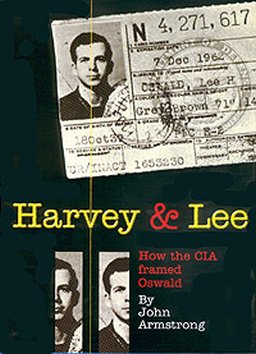
John Armstrong
Arlington, Texas: Quasar Ltd., 2003
$40, plus postage, from <www.jfkresearch.com/armstrong/>
This is a major publishing event in the JFK assassination world. Parts of Armstrong’s work has been on the Net and he’s spoken at some of the big JFK conferences. His work-in-progress became spoken of as ‘the John Armstrong research’; and finally we have the book, a self-published 1000 pages; plus a CD-Rom containing documents he cites. (I haven’t even looked at the CD-Rom yet.) Since one reading of this (and some sections I merely skimmed), is all I have managed so far, and that is barely scratching the surface of 1000 pages, this is a provisional report; first reactions.
This is a staggering piece of research, twelve years of it, and a lot of money spent in the process. Armstrong has interviewed people who haven’t been interviewed since the Warren Commission – and many who have never been interviewed before. He has read official files no nonofficial had seen before him. Lots of new ground is broken here in all kinds of little subsections of the story. But it is far too long. If the text was copy-edited, he or she deserves a slap: the text is full of stupid little errors. The typesetting is eccentric: the text is covered in italicisation, bold and underlining. A potentially great 400 or 500 page book is buried in this behemoth. Or perhaps it shouldn’t be thought of as a book, but more as research assembled in book form.
Armstrong does three things. First, he is offering a theory of the assassination. His minute – microscopic – analysis of key episodes in the case is punctuated by chunks of the CIA’s covert activities in the 1950s and 60s: Armstrong wants us to see what the Agency is known to have been doing while the Oswald story unfolded. But his thesis that the CIA killed JFK and framed Oswald fails for the same reason that previous versions of this have failed: no matter how plausible the idea, no matter how much detail we are given of other, analogous things the CIA was doing in the post-war years, Armstrong cannot show who was doing the shooting; and he cannot identify the CIA conspirators. The only plausible conspirators he offers are Jack Ruby and Lee, one of the two ‘Oswalds’ in the story. Both have connections to the CIA-funded anti-Castro operations; but that is all.
The second thing Armstrong does is show in great detail how the FBI ‘edited’ the evidence about the shooting. The FBI had all the evidence collected by the Dallas police sent to Washington and a lot of it didn’t return. Armstrong thinks the editing was done to conceal evidence of the two ‘Oswalds’; and while this looks very plausible, it is not conclusively demonstrated.
Thirdly, and centrally, Armstrong takes on the ‘two Oswalds’ question, which has been around since 1967. It arose first because there seemed to be someone pretending to be Oswald, apparently framing the other, genuine ‘Oswald’. Professor Richard Popkin detailed this first in his The Second Oswald (London: André Deutsch/Sphere, 1967). Then ‘Oswalds’ with different heights and slightly different faces were noticed. A decade after Popkin, Michael Eddowes published The Oswald File (New York: Clarkson Potter, 1977), which concluded that one ‘Oswald’, the American Marine ‘Oswald’, went to the Soviet Union but another ‘Oswald’ came back in his place, a ringer being run by the Soviets, who shot the President. In Alias Oswald (Manchester, Maine; GKG partners, 1985) Robert Cutler and W. R. Morris argued that the second ‘Oswald’, was not a Soviet spy but a US spy. In their analysis the switch from one ‘Oswald’ to the other took place in 1958 while Oswald was serving in the Marine Corps in Japan.
By dint of minute examination of the paper record and a lot of phone-bashing and travelling, Armstrong validates the Cutler-Morris thesis – there was a switch – and has tried to trace the life of the ‘hidden’ Oswald. He appears to have established the existence of an intelligence operation which began with two boys, of different heights, but who looked similar and who lived parallel lives. One, Harvey, was Russian-speaking, probably a refugee from Eastern Europe; the other, Lee, was an American.
Penetrating the Iron Curtain
It begins in the early 1950s, some of the cooler years of the Cold War. US intelligence had no reliable information on the Soviet Union. (This was before U-2 over-flights and satellites.) Soviet nuclear arms, even the Soviet economy, were a mystery. All the agents sent in by CIA and MI6 had been turned or captured. How could they get agents in? One way was to send them in as defectors. There seems to have been a CIA programme of defectors – Armstrong discusses some of the others – in which, he hypothesises, there was an attempt at a better class of defection. Armstrong believes the CIA ran two real identities in parallel, merged them – Lee and Harvey became Lee Harvey – and switched them just before the apparent defection of the American ‘Oswald’, Lee. Thus the CIA would insert into the Soviet Union a defector, Harvey, with two outstanding characteristics: one, unknown to the Soviet authorities, he could speak Russian; two, if Soviet intelligence checked his biography, they would find the American ‘Lee Oswald’, not a ‘legend’ but a real life. If this seems elaborate, Armstrong reminds the reader of the Soviet use of ‘illegals’, and quotes the example of Molody, ‘Gordon Lonsdale’, who operated in the UK.
This hypothesised CIA plan entailed both boys being in the Marines at the same time. Armstrong shows reports and presents recollections of ‘Oswald’ in two places at the same time through secondary school and in the Marines. The two ‘Oswalds’ explains the mass of contradictory material about Oswald in the Marines: one who couldn’t shoot; one who could: one who was an apparent Marxist and read Russian, the other who didn’t: one who was outgoing and a brawler; the other a bookworm. The plan also meant two ‘mothers of Oswald’, two ‘Marguerite Oswalds’. Here the programme didn’t extend to two women who looked similar: one was tall and elegant and the other short and plain. If Armstrong is correct, and the evidence looks convincing on one reading, a woman spent nearly ten years, pretending to be ‘Marguerite Oswald’, following the real Marguerite round the country, taking a series of shit-jobs to do so.(1)
It should be noted that there is no evidence, either paper record or firsthand, that this scheme took place. Armstrong infers it from the evidence of the two ‘Oswalds’. If this is true, Armstrong has uncovered the most elaborate intelligence operation (and done the greatest piece of espionage detective work) I have ever read about.(2)
Into the CIA’s anti-Castro underground
In Armstrong’s hypothesis, after Russian-speaking ‘Harvey’ defected, adopting Lee’s identity, Lee Oswald remained in the US, disappearing into the CIA-funded, anti-Castro world. Armstrong traces ‘Lee’ by collecting all the reports of ‘Lee Harvey Oswald’ which don’t fit the official, Warren Commission biography of Oswald: anomalous sightings, collected by the FBI and the police. Armstrong follows the American, anti-Castro activist Lee Oswald through his role in framing Harvey Oswald, right up to a late night meeting in a cafe with Jack Ruby on 21 November 1963, and into the Texas Book Depository on the 22nd. Armstrong has produced the revision of all revisions: two ‘Oswalds’ in the Book Depository: one, Lee, on the 6th floor with another man, framing the other, Harvey. (Armstrong doesn’t quite say that Lee fired from the sixth floor but it is implicit that he or the unidentified other man did.)
Some of this is convincing and some not. For the biography of the American, Lee, and particularly for the later events close to the assassination, Armstrong relies almost entirely on eyewitnesses; and eyewitnesses are generally not reliable. However, he has many of them all saying roughly the same thing; can they all be mistaken?(3)
There is one other recent version of these events which places Oswald on the 6th floor, the confession of Loy Factor in The Men on the Sixth Floor.(4) Factor also places Ruby and Oswald together in the conspiracy. Factor claimed to have been a member of the conspiracy, recruited as a marksman by a man he called ‘Wallace’. He identified his ‘Wallace’ as Malcolm Wallace nearly a decade before the unidentified print found on the famous sixth floor was apparently identified in 1998 as that of Malcolm Wallace.(5) But should we believe Factor? He had been brain-damaged during military service in WW2 and by the time he was talking he was old and ill. (He is now dead.) How much of what he said should be taken seriously?(6) No-one shooting from the front is mentioned by him. He places Jack Ruby at meetings to set-up the shooting, but no evidence linking Ruby and LBJ exists. (7) Factor’s ‘confession’ looked like more confession nonsense (8) because his account of the shooting placed him, ‘Mac’ Wallace and Oswald on the 6th floor of the Book Depository; and it had become an article of faith among the Warren Commission critics that if anyone was firing from the 6th floor, it wasn’t Oswald, who was sitting in the canteen drinking a Coke at the time. But Armstrong gives us two ‘Oswalds’, one on the 6th floor, where Factor placed him; and some witnesses on Dealey Plaza saw someone who resembled Wallace at the window of the 6th floor before the motorcade appeared. Armstrong’s thesis makes Loy Factor’s story more plausible than it had seemed.
Although Armstrong believes the CIA did it, he is aware of the Malcolm ‘Mac’ Wallace and LBJ thread which has been slowly insinuating itself into the JFK assassination research community.
On p.40 Armstrong gives half a page to the 1951 murder by ‘Mac’ Wallace of a former boyfriend of LBJ’s sister.
On p.656 Armstrong cites the Sample-Collum book, The Men on the 6th Floor, which includes Loy Factor’s ‘confession’, as the source of a claim about the identity of the man impersonating Oswald at the Soviet Embassy in Mexico City – but doesn’t mention Loy Factor around whom the book is built.
On p.812 Armstrong tells us:
‘Some researchers speculate that the man wearing the horn-rimmed glasses and the brown coat [seen at the window of the sixth floor of the Book Depository] may have been Lyndon Johnson’s associate Mac Wallace whose fingerprint may have been found on one of the boxes near the window…’ .
On p.375 we are given a page and a half on Billy Sol Estes, Johnson’s involvement, the murders of witnesses to Estes’ fraud and an account of the 1984 exchange of letters between Estes’ lawyer and the Justice Department in which Estes named Wallace as the perpetrator of eight murders for LBJ, one of them JFK’s. But Armstrong has omitted JFK’s name from his version of the Estes’ list.
What this means I don’t know. Armstrong has included a fragmented summary of the Estes-Wallace-LBJ thesis but has omitted Estes’ naming of Wallace as the organiser of the assassination. He must think the material of some interest or relevance because he included it (and he didn’t include a mountain of other material). But why miss JFK’s name off the Estes list?
While in prison after shooting Oswald – if Armstrong is correct, after shooting Harvey –Jack Ruby gave a letter to a fellow prisoner who was getting out and the letter survived.(9) It included this:
‘As soon as you get out you must read Texan looks at Lyndon and it might open your eyes to a lot of things………One more thing, isn’t it strange that Oswald who hasn’t worked a lick most of his life, should be fortunate enough to get a job at the Book Building, two weeks before the president himself didn’t know as to when he was to visit Dallas, nowhere would a jerk like Oswald get the information that the president was coming to Dallas. Only one person could have had that information, and that man was Johnson who knew weeks in advance as to what was going to happen because he is the one who was going to arrange the trip for president, this had been planned long before president himself knew about it, so you figure that one out. The only one who gained by the shooting of the president was Johnson, and he was in a car in the rear and safe when the shooting took place. What would the Russians, Castro or anyone else have to gain by eliminating the president. If Johnson was so heartbroken over Kennedy, why didn’t he do something for Robert Kennedy? All he did was snub him.’
Ruby’s reference to ‘Texan looks at Lyndon’ is to the book ‘A Texan Looks at Lyndon: a study in illegitimate power‘ by J. Evetts Haley (1964) which recounts some of Johnson’s political career and, in one chapter, discusses the string of murders in the Billy Sol Estes scandal in 1962.(10) After describing ‘Mac’ Wallace’s 1951 conviction for murder, and his connection to Johnson, Haley hints strongly that Wallace was the killer in the Estes-linked cases, something which Estes confirmed twenty years later. In this reference and the succeeding lines Ruby is pointing the finger at LBJ and directing the reader to the one book then published which had the information about Johnson and Wallace in it.
JFK and Vietnam
Did JFK plan to leave Vietnam? This has been examined in great detail in a brilliant essay by J. K. Galbraith – that’s James K. Galbraith, the son of the famous economist and writer J. K. Galbraith – in the October/November 2003 issue of Boston Review.(11) Building on the work of Peter Dale Scott and John M. Newman (JFK and Vietnam) and using documents and tape recordings made in the White House released by the Assassination Records Review Board (ARRB)(12) Galbraith proves, using primary sources, that JFK (and Defense Secretary Robert McNamara) had taken the decision to quit Vietnam, with or without victory. It was all about timing and presentation.
‘John F. Kennedy had formally decided to withdraw from Vietnam, whether we were winning or not. Robert McNamara, who did not believe we were winning, supported this decision. The first stage of withdrawal had been ordered. The final date, two years later, had been specified. These decisions were taken, and even placed, in an oblique and carefully limited way, before the public……..’
Galbraith is one of those who see JFK as having a radical foreign policy.
‘Kennedy’s decision to withdraw from Vietnam was….. also part of a larger strategy, of a sequence that included the Laos and Berlin settlements in 1961, the non-invasion of Cuba in 1962, the Test Ban Treaty in 1963. Kennedy subordinated the timing of these events to politics: he was quite prepared to leave soldiers in harm’s way until after his own reelection. His larger goal after that was to settle the Cold War, without either victory or defeat – a strategic vision laid out in JFK’s commencement speech at American University on June 10, 1963.’ (13)
‘John F. Kennedy’s lasting desire regarding the manned lunar landing program is recorded in National Security Action Memoranda 271 (a document kept secret for almost twenty years) in which he boldly called for the development of a program of substantial co-operation with the Soviet Union in matters relating to outer space, including collaboration in lunar landing programs; which he authorised and signed on November 12, 1963 – ten days before his dreadful assassination in Dallas. Yet to this very day its full significance is glossed over by the mass media and historians alike. Instead, they much prefer to centre on his now almost sacred May 25, 1961, speech, in which he first inspired so many Americans to reach for the moon.'(14)
And who was the space programme’s best friend on Capitol Hill? The senator for Texas, Lyndon Baines Johnson, who ensured that most of the space programme money got spent in his patch.
Notes
1 It isn’t clear if the ‘mother’ of Harvey, the Russian-speaker, was actually his mother or an intelligence officer playing the role.
2 Was the ‘two Oswalds’ defection scheme the only one of its kind or merely an example of a wider operation involving other ID switches? If the latter, no other evidence has been uncovered thus far.
3 A serious-minded sceptic would say ‘yes’ to that question. Armstrong quotes people remembering what Oswald’s mother looked like nearly 40 years before. Can you remember what a neighbour looked like 30 or 40 years ago? Armstrong’s earlier version of his ‘two Oswalds’ thesis is attacked at <http://mcadams.posc.mu.edu/2oswalds.htm>; Harvey and Lee is reviewed by Walt Brown at <www.jfkresearch.com/critique/ critique-view.html >
4 <http://home.earthlink.net/~sixthfloor/>
5 This match has been disputed by some and supported by another print expert cited by Barr McClellan in his Blood Money and Power (see Books below). Resolving this is the single most important item on the assassination agenda at the moment.
6 I found his account in The Men on the Sixth Floor oddly compelling: the not very bright, crack-shot Indian, meets Wallace, boasts of his shooting ability, is hired, and after the shooting is dropped at the bus station to catch the bus home!
7 I asked Google for ‘LBJ and Jack Ruby’ and found a googlewhack – a query with only one hit; and the hit was to a Lenny Bruce sketch. For ‘LBJ + Jack Ruby’ there were 2000. One of them <www.jfklink.com/articles/Shari.html> is a 1999 interview with one of Ruby’s strippers of the period, Shari Angel, who says she saw Ruby and LBJ together some months before the assassination. Given the unreliable nature of human memory, it is difficult to give much credence to a 36 year-old recollection.
8 There had been a number of spurious confessions by then.
9 The letter is at <http://63.74.13.36/postp197887.html> Another letter exists in which he accused Johnson but its full contents have not been made public, merely a sentence or two.
10 Evetts was a leading Texan member of the nativist ‘radical right’, founder of an organisation called Texans for America. See the profile of him at <www.tsha.utexas.edu/handbook/online/articles/view/HH/fhahj. html>. The book is still widely available second-hand, for example at <www.abebooks.com/>
11 <www.bostonreview.net/BR28.5/galbraith.html>
12 And politely demolishing Chomsky en route. Chomsky, great man though he is, has a total blind spot where Kennedy is concerned.
13 Just how tricky a manoeuvre this might have been against the wishes of the military is illustrated by another Galbraith paper in American Prospect in 1994, ‘Did the U.S. Military Plan a Nuclear First Strike for 1963?’ <www.prospect.org/print/V5/19/galbraith-j.html>
14 From < http://www.birmo.co.uk/jfk/work_in_progress/index.htm> At that address there is a detailed discussion of NSAM271.