
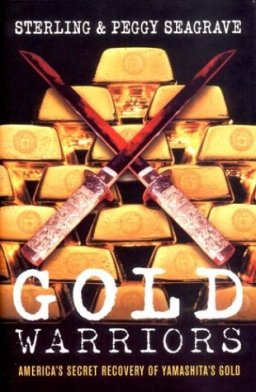
Sterling and Peggy Seagrave
London: Verso, 2003, h/b, £17
The story in brief: before and during WW2 Japan stripped the countries it occupied of its transportable wealth — gold and other precious metals, diamonds, cash, bonds and so on. As the war turned against them this was buried in various locations, many of them in Manila. After the war some of the treasure was recovered by the US and used to fund some of its political and covert operations in the immediate post-war period; giant political slush funds were created under the control of……well, this isn’t clear. At one point we are talking about the CIA; and then we are told that Richard Nixon, a politician, gave control of the biggest of the funds to the Japanese Prime Minister. (We are talking tens of billions of dollars here.)
If true, this is big, big stuff, impacting on a large number of areas in post-war history, from the funding and manipulation of Japanese politics, through to the 1980s and the putative existence of a kind of parallel CIA, which the authors call The Enterprise, in which a pantheon of well known names from the hard right of the American intelligence and military are said to be involved. But is it true? As presented here the answer can only be: it might be true. For, in the first move of its kind I have come across, the authors have not documented the book fully, placing what they claim is their main evidence on two CDs which can be bought from their Web site. These I haven’t seen. However, Douglas Valentine has seen them and in a piece in Counterpunch (7) he wrote that said CD’s ‘do more than prove their case’. Taking Valentine’s assessment seriously, this then is big, big stuff. However, as a book, this is unsatisfactory not only because many of the key claims are not documented here but also because interspersed between the historical and parapolitical sections the authors have placed accounts of the attempts by various individuals and consortia to find unrecovered caches of ‘Yamashita’s gold’. These adventure stories sit uneasily with the historical and parapolitical material.
When the book arrived I knew immediately that I wasn’t competent to assess it but I knew a man who was, David Guyatt, who has been working in the same area. In reply to my invitation to review Guyatt e-mailed me:
‘Ordinarily, I would be delighted to review a book for Lobster but it would be unfair of me to review Seagrave. You’ll understand if you take a look at the main page of my website (www.deepblacklies.co.uk) and click on the link towards the bottom under the heading of “The Seagrave Affair”…..the short version is that Seagrave published a number of documents I provided to him about four years ago under an agreement of confidentiality. Some of these I later published with The Secret Gold Treaty (8) and so not only did he breach a confidentiality agreement but also copyright. I privately insisted he cease publishing but he didn’t have the good grace to even answer my repeated messages to him. So, I threatened to sue his server and they, in turn, told him they would block his website unless he provided the necessary undertaking in writing. We don’t talk anymore and I won’t have anything to do with him or his book (which incidentally, someone has made available electronically on the internet free and gratis………).’
Notes
6 < http://www.informationclearinghouse. info/article3995.htm > [Accessed 3 November 2003].
7 < http://www.counterpunch.org/valentine 09262003.html >
8 Reviewed by Terry Hanstock in Lobster 41.