
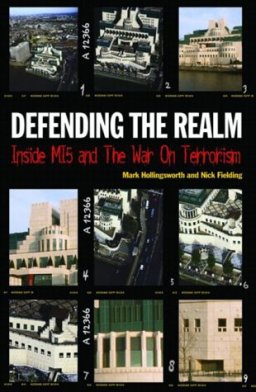
Mark Hollingsworth and Nick Fielding
London: Andre Deutsch, 2003, p/b £8.99
An updated and expanded version of Defending the Realm: MI5 and the Shayler Affair which was reviewed in Lobster 38, this account of MI5’s adjustment to the post Cold War world is one of the best books on the UK’s intelligence services, up there with Stephen Dorril’s MI6 book, Paul Lashmar and James Oliver’s book on IRD and Richard Aldrich’s The Hidden Hand. Rereading it, I was struck by the following.
Although we now know quite a lot about MI5’s recent history, almost none of it has come from MI5 itself, despite the talk of openness and its Web site. A good deal of the key information has come from David Shayler who is at the centre of this book. It is easy to forget what an important source Shayler has been.
Publicly, the Labour government totally failed to take Shayler’s information on board and swore allegiance to the sanctity and virtue of our secret servants. (But privately, who knows?) Even Robin Cook, then Foreign Secretary, felt obliged to parrot the line written for him by civil servants on the subject.
Another source for some of this information is bureaucratic infighting among British security and intelligence agencies for budget share and status. This used to be kept within Whitehall but is now conducted in part in the media.(1)
Like a barium enema, a whistle-blower like Shayler illuminates the nether regions. The fact that the Intelligence and Security Committee of the House of Commons has never taken written or oral statements from Shayler or Richard Tomlinson, the most important insider sources on our spooks in the post-war period, shows precisely how little independence the committee actually has. (2)
As it was in the hardback, Shayler’s critique of MI5 submitted to a Cabinet Office review is one of the appendices. His complaint is that MI5 was was old-fashioned and out of touch. Reading this again I am still no clearer as to why Shayler blew the whistle the way he did. No Philip Agee, he! I wonder if Shayler thought things they would be better under Labour and he wouldn’t get clobbered? It isn’t clear from this account.
Notes
1 See for example the article criticising MI6 by former British ambassador, Peter Heap, ‘The truth behind the MI6 facade’ in The Guardian 2 October 2003.
2 In the Independent 2 September 2003, ISC member Alan Beith said of the committee:
‘I believe the ISC provides effective scrutiny, by parliamentarians and reported to Parliament, to a degree not exceeded in any other country except to the extent that other systems, notably the US system, give committees direct control of the budgets they scrutinise. It is not in any way controlled by government.’
This is self-delusional nonsense.
Not that the ISC doesn’t have its uses for the state. In response to the criticisms of MI6 by former ambassador Peter Heap (see note 1), the Foreign Office said in a statement. ‘The reports by the parliamentary intelligence and security committee regularly praise the quality of intelligence work.’ David Leigh, ‘FO denounces attack on MI6’, Guardian 3 October 2003.