
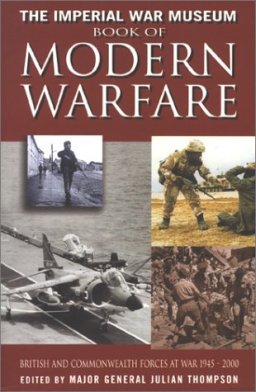
The Imperial War Museum book of Modern Warfare: British and Commonwealth Forces at War 1945-2000
Edited by Major General Julian Thompson
London: Pan Books, 2003, £8.99
This is the paperback edition of the book published by Sidgwick and Jackson a year ago. It contains 15 essays on conflicts that have involved British armed forces since 1945. A number of the contributions are rather good and should be read by anyone seeking a grounding in the topic concerned. This is particularly so with regard to the chapters on Palestine (1945/1948), Korea (1950/1953, at 35 pages a welcome distillation by General Sir Anthony Farrar-Hockley of his 2 Volume Official History), Kenya (1952-1956 by General Sir Frank Kitson) and Cyprus (1955-1959).
Looked at in a cold historical and political context the Zionist founders of the modern state of Israel come across very badly; while the EOKA group appear to be dismal irredentists basking in the kind of exaggerated nationalism recently seen with lethal consequences across the Balkans. Given that Cyprus and Palestine both remain at the time of writing serious regional and international disputes, any British observer looking back at the UK’s previous involvement in these areas might be forgiven for adopting an ‘I told you so’ attitude.
Unfortunately other chapters, whilst efficient enough from a military point of view, are either considerably less illuminating or are (unintentionally?) revealing of the way that the UK military has been subject to cost cutting and pruning by the Treasury in much the same manner as all other public services and industries in Britain.
The chapter on Suez manages to completely avoid the overall political context. There is no mention that the Hungarian insurrection took place at the same time. The bowing of Eden at al to US instructions backed with threats to cause financial chaos to the Sterling area to stop the fighting is not recorded. Yet surely this is the essential prism through which to view this debacle? One is struck when reading this episode that the UK political leadership could clearly have continued the fighting in Egypt for long enough to have secured complete control of the Suez Canal (another 24, maybe 36 hours) and then have told the US that they would run it in future in a manner similar to the way the US operated the Panama Canal, the jurisdiction and operation of which was not, apparently, open for debate within the broader international community. US threats to the Sterling area? Would Eisenhower and Dulles really have bankrupted their major European ally? Could not convertibility of Sterling have been suspended for a few weeks? The lack of resolve shown in 1956 by the British political elite when dealing with Washington DC is striking, and the lack of comment on this rather curious. (1)
Somewhat more illuminating is the essay on the fighting in Muscat and Oman in 1958/1959. But even in this instance the political backdrop is neglected. The author is right in saying that the origins of this ‘little war’ can be traced back to the Buraimi Oasis Affair of 1953-1955, but fails to explain why. Buraimi involved Saudi Arabia trying to seize an area thought to be rich in oil that was within the jurisdiction of the British Protectorate of Muscat and Oman. Saudi Arabia did this at the behest of the Arabian American Oil Company. At the time (pre-Suez) Britain successfully forced a Saudi withdrawal. The British wanted the oil reserves to be exploited by the Iraq Petroleum Company, a UK-dominated concern. 2
When events started up again in 1958 it was not only after Suez but also after the April 1957 Defence White Paper. In the context of the post-Suez situation in the Middle East it simply isn’t good enough to treat Muscat and Oman as an isolated incident. The serious fighting in the region broke out in November 1958 with a British counter attack on various tribal insurgents. This took place against a backdrop of President Nasser announcing the union of Egypt with Syria (February 1958) and Yemen (March 1958) and a pro-Egyptian coup in Iraq (14 July 1958). The latter event resulted in a speedy US intervention in Lebanon (15 July) and a similar British operation in Jordan (17 July).
The Defence White Paper announced that although Britain would remain a world player via the possession of nuclear weapons defence expenditure would be ‘held’ at 7% of GDP with retrenchment in other areas. Retrenchment in this instance meant ending conscription (implemented in 1960 and something which placed the UK entirely on its own within NATO and Europe in relying on small volunteer forces), merging regiments and pretending, for a little while, that there was amongst other things no future for supersonic aircraft. (3) In other words the Treasury got a handle on defence spending. The result of the Muscat and Oman fighting in 1958-1959, which ended successfully for the British, was that, in the words of the author,
‘ ….the oil company was delighted….’; and
‘….the most important effect of the campaign was that it ensured the continued existence of the SAS….’
To put it another way Britain saved some oil rich desert using a regiment the SAS that the accountants back home were looking to scrap in the Treasury defence cuts that followed the 1957 White Paper. While one appreciates that the military professionals were pleased at saving the SAS, what is striking is the acceptance that it was no longer possible for Britain actually a very wealthy European nation to have a conscript army on the lines of everyone else in NATO.
This theme of small, highly professional and superbly trained British forces keeping the (western) peace in unstable parts of the world is stressed throughout General Sir Walter Walker’s account of Brunei and Borneo (1962-1966). A successful operation, this ends with the glowing praise of Denis Healey, Minister of Defence at the time, to the effect that it was
‘….one of the most efficient uses of military force in the history of the world….’
If Healey meant by this that a war had been fought and won very cheaply compared, say, to the US efforts in Vietnam at the same time then this was probably true. But Walker, like his other contributors, curiously avoids the political background. In 1966 there was to be no reward from the then government to the British military for such expertise and economy. Instead only a few weeks after his speech in the House of Commons Healey was announcing a ‘rationalisation’ of the UK’s remaining overseas commitments ‘on the pattern set by US Defence Secretary Robert McNamara and the Pentagon’ but actually caused by ‘economic stringency’. (4)
Defending sterling
Part of this was the closure of the Singapore naval base and the withdrawal from virtually everywhere East of Suez. Thrown in was Healey’s claim at the time that aircraft carriers were now ‘obsolete’ and that Britain would scrap its remaining vessels of this type over the next few years a claim not made by any other major maritime nation then or subsequently. One can only conclude that the prime movers in this episode were, once again, the Treasury, seeking to drive down government spending, contain costs and maintain the value of sterling. A disclaimer clause of some kind might be added to the effect that if as a result of these long term goals being pursued government ministers had (and still have) to make idiotic statements on a reasonably frequent basis then the Treasury could (and should) not be held responsible for this.
The section dealing with the withdrawal from Empire concludes with a gloomy chapter on South Arabia and Aden (1964-1967). This has little to cheer no efficient uses of military force, no SAS triumphs, no regiments being saved from the Treasury. It is in fact a thoroughly dismal account of the British abandoning the area to groups of rioters and lightly armed nationalists who were egged on and supported by President Nasser. 1% of the effort and cost expended on either of the Iraq wars would have routed the opposition and kept Aden in British hands permanently. It is perhaps worth stating that Aden (and its neighbour Yemen) do not possess oil. Oman, next door, and the scene of more colonial fighting (1970-1976) does. Hence the British left Aden but stayed in Oman. From the Arab point of view today the British walking away from some rioters in Aden and the US deciding in 1982 that Somalia was not worth the candle may well give the impression that by marginally upping the ante it is possible to beat the West. Both Jack Straw and George Bush and co. have gone to some lengths in recent months to dispel this notion.
There are large chapters on both the later fighting in Oman and Northern Ireland. Whether the latter could be categorised as a ‘war’ of quite the same type as described elsewhere in the book is perhaps debatable; as is the assumption made by the author, Michael Dewar, that it remains ‘unfinished business’.
With the exception of the Falklands (1982) the remainder of the contributions describe conflicts that are ‘ongoing’ Bosnia, Kosovo, Iraq and in which the British contribution, though significant, has often been less than that of either the US or NATO. (There is no mention of either Afghanistan or Sierra Leone, both having taken place since publication.)
After their soldiering days Walker and Kitson, who have pieces published in this book, became convinced that British society was facing subversion from ‘Communist’ activities in much the same way that Malaya (or Korea) had in the ’40s and ’50s. Walker was particularly active in 19741976 in manoeuvres that aimed to replace the Wilson government with a non-party coalition. These were interesting times: the miners’ strikes of 1972 and 1974, triggered by years of disputes about pay and colliery closures, may indeed have looked to some like deliberate ‘Communist’ agitation.
It would be interesting to ask either Walker or Kitson whether they considered that the objections the miners had to pit closures, or railway staff had to Beeching etc, could possibly be similar to their own frustrations at regiment amalgamations and disbandings, the cancellation of TSR2, the scrapping of aircraft carriers and the withdrawal from east of Suez. One conclusion they could have reached had they looked at the supposed economic arguments was that the hand of the Treasury can be seen at work just as much in the retreat from Empire and adoption of a new world role (chief supporter on the block of the US ) as it can in the failure to pay decent pensions, build a proper Channel Tunnel rail link or support a decent, national, industrial structure.
Notes
1 Perhaps these sentiments are slightly beyond a book of this type which nevertheless contains much valuable information. The most striking aspect of the Suez climb down in Britain was the replacement of Eden with Harold Macmillan, a far more pro-US leader.
2 The Buraimi saga was well known at the time and remained in public consciousness for some years. It was sent up remorselessly as a typically blimpish episode by the Goons in ‘The Nasty Affair at the Buraimi Oasis’, broadcast on the Home Service on 4 October 1956, during bizarrely the build-up to Suez.
3 The White Paper argued that future wars would be decided by nuclear weapons and missiles.
4 These interpretations of Healey’s/the Treasury’s policy can be found in Alan Sked and Chris Cook, Post War Britain A Political History (Harmondsworth: Penguin, 1979).