
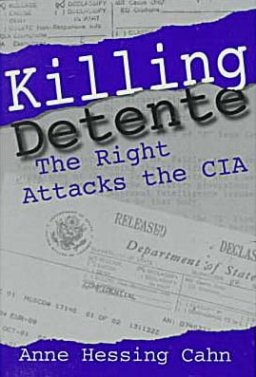
Anne Hessing Cahn
Penn State University Press, 1998, $19.95, p/b
The ‘Team B’ episode of 1976/7, the subject of this book, which saw a group of the CIA’s critics on the right being given access to the Agency’s raw intelligence data, was one of the key moments in the counter-attack against detente with the Soviet Union in the 1970s.
With the collapse of the Soviet empire, it is easy to regard what went before the second Cold War as at best irrelevant and at worst, in the right’s version, as a terrible mistake. In the other way of looking at it, the Cuban Missile Crisis had demonstrated that the Cold War had become so dangerous it had to be managed; and detente was that management.
Detente had two major American lobbies against it. The military-industrial complex and the Republican right (often the same people, of course) didn’t want it because management implied reduction, which had implications for power, careers, status and wealth. Mostly using interviews with the participants of the time, Cahn’s book describes, in clear, straightforward prose, how groups fronting those two lobbies created a new Soviet ‘threat’ in 1976/7.
Spending on the military-industrial-intelligence complex is affected by the definition of the ‘threat’ facing America: low threat, lower spending; high threat, higher – as 9/11 demonstrated after which military and intelligence budgets went up. In the 1970s the only ‘threat’ was the Soviet Union and the key to the official measure of the ‘Soviet threat’ was the National Intelligence Estimates, prepared by the CIA. In the early 1970s those CIA estimates began to come under attack from the right who claimed that the ‘threat’ was being minimalised in pursuit of detente. Eventually these critics of the CIA’s estimates generated a sufficient head of steam that the then Director of the CIA, George Bush, agreed to allow a group of them to have access to the raw data that the CIA analysts used to prepare their estimates of ‘the threat’. Hence ‘Team B’. In due course Team B duly concluded that they had been right all along! This provided the ammunition for the groups lobbying for a revived Cold War and more military spending.
There is real continuity here, even though these events are almost 30 years ago. George Bush is not the only familiar name in the story. One of the members of the Team B was Paul Wolfowitz, now Deputy Secretary of Defense.
In the final paragraph of this exemplary piece of research, Cahn notes that the Team B exercise was crucial to a movement which led to the spending of a trillion and a half dollars on defence, turning America into a debtor nation, ‘to counter the threat of a nation that was itself collapsing’.