
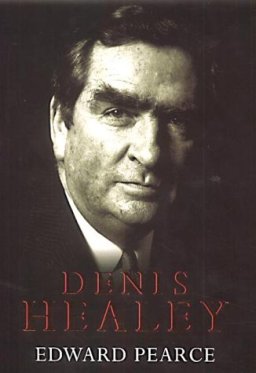
Edward Pearce
London: Little, Brown, 2002, £25, h/b.
Compared to the present crop of media-trained, PR-conscious, line-following, careerist pigmies who comprise the current Labour Cabinet, Denis Healey looks like a giant from a golden age.
Before his well known roles as Minister of Defence and Chancellor of the Exchequer (during the Tory-induced inflation of the late 1970s), Healey was a central figure in the Anglo-American defence establishment, an intellectual who knew enough to talk and write about NATO policy and nuclear strategic theory, not just deliver briefings. (Cf the current Defence Secretary, Geoff Hoon…..) Pearce conveys this, though he doesn’t give Healey enough weight. (It matters not that the conversations and disputes of the nuclear strategic theorists were largely insane; they were taking place and Healey was a player.) More importantly Pearce doesn’t convey any sense of the wider, political dimension of that Cold War Anglo-American relationship. Pearce gives us minute details about debates inside the Labour Party in the 1950s but only has this say about that relationship:
‘Healey shared, with a whole generation of Labour right-wingers from Hugh Gaitskell to Shirley Williams, a deep affinity with democratic liberal America’. (p. 156)
This is true but it isn’t the point. In practice that ‘affinity’ led them to deal with, sometimes be funded and sponsored by, the institutions of the American state. It wasn’t ‘democratic liberal America’ which paid for the American tendency in Labour to spend the 1950s visiting America, getting published and building careers. It was the State Department and the CIA. This is completely missing from Pearce’s account. And it has been omitted. Even if Pearce is unaware of the work of the Richard Fletcher (1) and his successors – and Lobster is one – the institutions of American political power are in Healey’s own account of his life, The Time of My Life: the Ford Foundation, the Bilderberg conferences and the Congress for Cultural Freedom are in Healey but not in Pearce. Sam Berger, the US labour attaché in London is described as such by Healey; in Pearce he’s just a friend. Even the CIA is missing from Pearce’s index. Healey is unabashed about these American institutions and in his account they are just part of the picture.
This is not the only area Pearce refuses to take on board. There is nothing on the Wilson plots and the fact that Healey’s wartime flirtation with communism loomed large in MI5’s disinformation strategy. The entire 1974-7 period of hysteria on the right, intense covert operations and widespread psyops against the Wilson government, the Liberals, the left and the unions gets only the following:
‘The tone of the press was growing hysterical. It was possible for a talented, but sometimes silly journalist, Peregrine Worsthorne to write in the Sunday Telegraph that such was the power of the trade unions, that the old orders would have to turn to the army’. (p. 447)
And this from a man who edited the Freedom Association’s journal in the late 1970s and must have subbed and published articles on these matters!
Pearce has omitted the parapolitical subtext.
That said, the book is very good as far as it goes. Pearce is a fine writer, with strong opinions which he is not afraid to express.(2) But as Healey looms large in Labour Party and British politics from 1947 to the mid 1980s, this is also a history of British and Labour politics in that period; and Pearce has omitted too much, too obviously.
Notes
1 Co-author of CIA and the Labour Movement (Nottingham: Spokesman, 1977) and pioneer in the exposure of IRD’s role in post-war politics.
2 He is currently writing a splendid column in Tribune in which his rhetorical powers are regularly trained on Tony Blair et al to great effect.