
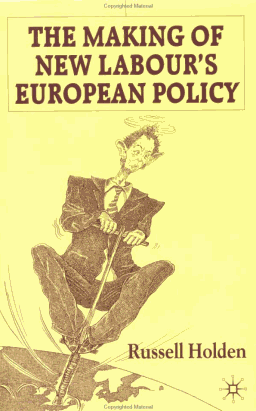
Russell Holden
Basingstoke: Palgrave, 2002, hb, £47.50
The author is an enthusiastic supporter of the ‘reforms’ of the Labour Party and a Senior Lecturer in European Studies. His thesis is that the changes in Labour’s policy from anti- to pro-EU membership are the core of the ‘reforming’ of Labour in the 1980s and 90s and have remained at the heart of the ‘New Labour’ project. His difficulty is that he has little evidence to support this thesis. Note the emphases I have added in the following quotes from Holden:
‘…the European issue, albeit through the vehicle of economic policy, became the core of the party’s policy change’ (p. 49);
‘….the European issue became the focus for unity and the driving force, albeit implicitly, within the Policy Review Process’ (p. 64);
‘Europe became the driving-force of party thinking, contributing substant-ially, though not always overtly, to the new sense of unity and purpose throughout the Labour Movement’ (p. 91);
‘…the European issue became a central, though not always explicit, element of party strategy geared to seeking a clear primary objective: securing political office.’ (p. 194)
It’s there at the centre but it just isn’t visible.
He tells us:
‘What has emerged……is a policy approach driven by more than electoralism. The evidence points to an accompanying sense of conviction based on the realisation of the value and inevitability of increasing European influence as part of a longer-term strategy to restore credibility and gain supporters’ (p. 184)
But he then tells us seven pages later:
‘Thus, a party portraying itself as modern was not willing to advance European policy beyond using it as a device to retain unity, aside from terms of grand rhetoric exploiting the openings generated by the tactic of mere opportunism.’ (p. 191)
Where is the ‘accompanying sense of conviction’ he found in the previous paragraph?
The author’s difficulties are understandable: his thesis is baloney. It is quite clear that the core of the ‘reform’ process begun by Neil Kinnock was appeasing the City on economic matters and America on NATO and nukes. In the 1980s most of the City was pro-EU, for a variety of reasons, not least a lingering sense that being in the EU would prevent ‘socialism’. But had the City been ‘anti’ the EU, Labour, reformed or not, would have been anti.
It has now been forgotten that between 1980 and 1986, the year of the publication of leader Neil Kinnock’s book Making Our Way, the Labour Party as an institution had grasped that the interests of the City of London were the core of Thatcher economics – Labour MPs’ constituents were unemployed because of it. You might have thought that since everybody hates the bankers, and they were getting fat in the 1980s, it wouldn’t be too hard to produce a popular campaign along those lines. This does not seem to have been considered. The City was perceived as controlling the news agenda and, if Labour were elected, as being capable of wrecking a Labour government. How the City would have accomplished the latter is unclear, though occasionally the expression ‘a run on the pound’ appears, and allusions are made to Wilson’s troubles in 1964-67 in the era of fixed exchange rates. Quite how this fitted in the world of floating exchanges of the late 1980s I never understood – and nor did they, I suspect.
For whatever reasons, after the 1987 election – never having seriously tried to even explain their economic beliefs – Labour’s leaders decided the game was up. Appeasing the City reached some kind of peak of absurdity when Labour decided to support entry into the ERM because it would be a guarantee to the City of Labour ‘bearing down on inflation’ – as if Labour, and not Edward Heath (and OPEC) had caused the 1970s inflation. I suspect that by the late 1980s Labour’s leaders – Kinnock, John Smith, Brown – had accepted as fact that it was Labour policies which were responsible for the 1970s inflation.
As for ‘New’ Labour’s European policies, in opposition between 1994 and 1997 such was the enthusiasm for the subject, Holden tells us:
‘Throughout the 1994-7 period…..the party preferred to defer on the European question wherever possible’ (p. 116)…’.
‘Consequently, this implied an implicit‘ – there’s that ‘implicit’ again – ‘recognition of the importance of Europe to policy-making considerations. However, much of this was very heavily camouflaged and determined by the overarching desire to defer on the European issue wherever possible…’ (p. 123)…
‘European matters were fully camou-flaged…’ (p. 127)
‘This was a further instance of the coating of camouflage on European policy…’ (p. 132) (all emphases added).
In government, initially there was talk of a new relationship with ‘our European partners’. But the idea was that the UK would become a leader of the EU by virtue of it bearing the gospel of American neo-liberal ideas – the so-called Washington consensus. Hard though this may be to credit, the stupid schmucks really seem to have believed that the other EU leaders were going to say ‘Hosanna’, throw their hats in the air and change all their policies.
In fact little has changed since the days of John Major – or Margaret Thatcher. The UK remains an island off the coast of mainland Europe with considerable ties to the US, not least through US ownership of the City of London, inter alia the world’s largest off-shore money-laundering centre. Some bits of the City are keen on the single currency and others, notably all those engaged in currency speculation, are not. The Treasury, which was always hostile to the Common Market/EC/EU, remains hostile to the single currency and further European integration, not least because they would reduce the Treasury’s powers. Gordon Brown, who got his fingers badly burned during the ERM fiasco of 1992, is wary of the single currency, fearing another ERM-style debacle. (2)
‘New Labour’ is stuck in precisely the same way that the Conservative Party was stuck and it is entirely unclear whether or not a pro-single currency propaganda campaign like those described in Andy Mullen’s piece above would work with so much of the printed media being hostile to it.