
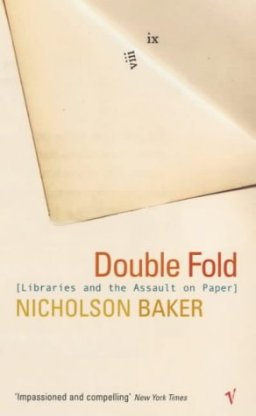
Nicholson Baker
London: Vintage books, 2002, pb, £7.99
See note (1)
In the third voyage of Gulliver’s Travels, Swift describes a visit to the Academy of Lagado, where ‘Projectors’ work at bizarre schemes like making silk from spiders’ webs. Whenever they meet problems, rather than admitting the futility of their efforts they clamour for more funding. Swift’s examples of scientific obsessiveness were based on actual projects undertaken by the Royal Society, but were he writing today he would find ample material for satire in the antics of technophile US librarians described in Nicholson Baker’s thoroughly-researched and passionate polemic. This is a world in which the archivist of a historical society orders volumes of the New York Times to be fed into a steam-engine of a vintage sawmill; in which the Deputy librarian of Congress purports to demonstrate the terminal brittleness of books pages by tearing one from a volume and crumpling it in his fist; in which the unsupported belief that treating books with diethyl-zinc will add 500 years to their results in potentially catastrophic experiments in a vacuum chamber at a NASA Space Flight Centre; in which a plan for preserving the US national archives’ textual records lists figures totalling 108; and in which almost nobody with responsibility will opt for the cheap and simple solution of buying additional storage space housing books in appropriately controlled conditions.
To talk of a ‘solution’, though, assumes that the problem is clearly identified, but as Baker shows, the destruction of paper texts and their replacement by microfilm is justified by librarians on grounds that shift through time or according to who is being interviewed. One major reason has been a fear, fuelled by inaccurate statistical projections, that exponentially increasing numbers of paper texts will be impossible to house. Verner Clapp, appointed director of the Council on Library Resources in 1956, aimed at the ‘steady space’ ideal, by which a library would remain at a particular physical size as original texts were dispensed with in favour of micro-surrogates. Yet, as Baker points out, the cost of microfilming far exceeds that of buying extra space, and the results are often lamentable, with poor quality reproduction and pages omitted: a ‘complete run’ of a journal may have up to 6% of its material missing. It is therefore vital to keep originals, but many US libraries have disposed of entire runs of newspapers.
If Swift’s shade broods over Double Fold, so does Orwell’s: for this is a world where ‘preservation’ actually means ‘destruction’. What is preserved supposedly, is the textual content; the artefact itself is cut into pieces to be photographed. Historical documents have disappeared in huge numbers from US libraries over the past 20 years: given away, sold, thrown out or pulped. William Welsh, Deputy Librarian of Congress, believed that ‘libraries shouldn’t be regarded as “warehouses of little-used material”‘, while the sinister Patricia Battin, of the Commission on Preservation and Access, has said that ‘the value, in intellectual terms of the proximity of the book to the user has never been satisfactorily established.’ History becomes increasingly privatised, with Bell and Howell holding a near-monopoly of reproduction rights for primary sources.
To achieve their dream of an electronic library, Battin and her kindred spirits manufactured a panic about the parlous state of paper texts, based on the highly sophisticated ‘double fold’ test: if you fold a page, origami-style, back on itself a sufficient number of times it will break or tear. According to this test, millions of volumes were at risk of turning into dust; but if the dust didn’t get them they might spontaneously combust, claimed the 1987 propaganda film Slow Fires. By repeatedly presenting such untruths library administrators attracted millions of dollars of public money which was used to dispose of the very material whose care was their responsibility.
One of the many intriguing features of this black farce is the extent to which important figures in its development had links with the CIA and the military. University Microfilms landed a big contract with the CIA’s predecessor, the Office of Strategic Services; Verner Clapp acted as a consultant for the CIA and employed J.C. Licklider, who later worked on the Pentagon’s early internet system; one of Clapp’s bulk-reducing projects was built by the missile technology firm AVCO; the current Librarian of Congress worked for Allen Dulles in the 1950s, and so on, with many other instances given. Baker also hints at vested interests: Stuart Lynn, who was a member of the Commission on Preservation and Access which recommended scanning and discarding, was on Xerox’s advisory panel at the time.
It is difficult, nevertheless, to discern an actual conspiracy at work in the story, though this may in part be owing to the book’s lack of a clear chronological structure. Rather, one gains the impression of administrators who dislike material objects, consider simple solutions unglamorous, and compensate for their humdrum bureaucratic life by working with new technology and large sums of money. One of Patricia Battin’s final newsletters insisted that all information repositories ‘must’ now make the transition to digital technology – a pronouncement to delight the IT industry and make the hearts of scholars sink.
Could it happen here? It already is: Baker opens his story in the British Newspaper Library at Colindale which in 1997 discarded seventy-five runs of Western European Journals. Shortly after reading Double Fold I spotted an item in the Independent about an Oxford University library which put valuable first editions, including a J. S. Mill, on sale for as little as £1 a volume; and in September 2002 the same paper published an obituary of Ian Mowat, Librarian at Edinburgh University, who envisaged his library as ‘a central player in the digital revolution’.
One can only hope that Nicholson Baker’s brilliant and disturbing study of the effects of these fantasies in the US will alert the relevant authorities in Britain to the threat posed by such dismal cliches; otherwise, where destruction of books is concerned, we risk making the Nazis look like amateurs.
Notes
1 Philip Conford is the author of The Origins of the Organic Movement (Floris Books, 2001; ISBN 0-86315-336-4; £14.99)