
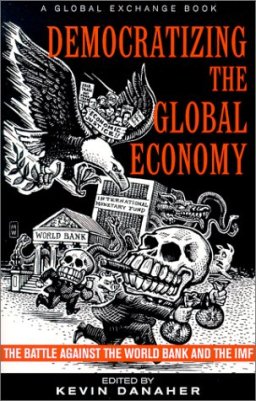
Kevin Danaher (ed.)
Common Courage Press, Monroe, Maine, U.S., 2001, $15.95
www.commoncouragepress.com
This volume contains 27 short essays by everyone from Fidel Castro (rather impressive, if he wrote it himself) through Chomsky, and Naomi Klein to Margot Smith, whose essay is titled ‘Granny Goes to Washington and Goes to Jail’. So: this runs from theory/history (in small doses, sans documentation) to how-to-organise-demos (lots of that), and tales of what it’s like being pepper-sprayed and clubbed by the police.
For ‘democratising the world economy’ in the title read world revolution, for that is what is being advocated. A ‘movement for global justice’ (Michael Alpert p. 70) sounds fine – who could oppose such a thing? – but when the leaders of this loose ‘movement’ get down to describing their alternative to the present situation, it doesn’t make a lot of sense to me. In a ZNet commentary Alpert offered:
‘……a.vision [of] a people-serving and democracy-enhancing internationalism…(1) in place of capitalist globalization, we are proposing to place a very good International Asset Agency, Global Investment Assistance Agency, and Global Trade Agency…….workers and consumers would be organized into democratic councils…….’
Democratic councils, huh? Enough to make the heart race!
George Monbiot, for example, in one of his Guardian columns, proposed, inter alia, a ‘world parliament’, an idea no less ridiculous than TUC General Secretary John Monks’ call a few years ago for ‘world works councils’.
Almost completely missing in these essays – one timid reference by Klein that I noticed – is the nation state. Yes, world revolution is going to be accomplished without the nation state. It’s not to hard to see why a left anthology by-passes the nation state: nation suggests nationalism and nationalism is the territory of the right; and for right-on American leftists the territory of the right is an unspeakable country inhabited by the likes of Pat Buchanan and other demons.(2)
But I find it hard to take seriously the programme implied in these essays without the nation state. Since both the World Bank and IMF are dominated by the United States, if they are to be defeated, or even just reformed, the US government – the US state – will have to be defeated or reformed; and as the tales of being pepper-sprayed in this volume remind us, you can’t just by-pass the national security state.
Before the language of globalisation, these issues were discussed in terms of multi- or trans-national capital – terms which appear very, very occasionally in this volume. I am not persuaded that we should move beyond this older vocabulary for it carries with it the idea that the problem is the power of the multi-/trans-national corporation over the nation state and its citizens. That something should be done about this I can imagine ‘selling’ to the average, apolitical British, French or German citizen. The more grandiose ‘vision’ of ‘a movement for global justice’ looks just as hard a sell as when it was offered as world revolution.
Notes
1 This, presumably, is the ‘real internationalism’ so often referred to but hardly ever defined by the Labour left. On this see the examples given in Lobster 33 pp.2/3.
2 If the American anti-globalisation left could hold its collective nose long enough to actually read Pat Buchanan they would find him looking rather like an ally in many areas. Buchanan also wants an end to the American empire. See, for example, his talk ‘The Millennium Conflict – America First or World Government’ given in January, at http://www.tysknews.com/Depts/New_ World_Order/millennium_conflict.htm