
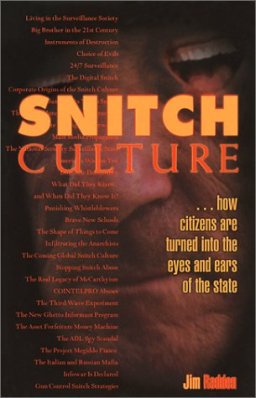
Snitch Culture: How the citizens are turned into the eyes and ears of the state
Jim Redden,
Feral House, U.S., 2000, $16.95 (pb)
Earth Rising: The Revolution, Toward a Thousand Years of Peace
Dr Nick Begich and James Roderick
Earthpulse Press, Ancorage, Alaska
$17.95, 2000 (pb)
(available through Flatland)
‘We live in a society driven by manufactured paranoia, where personal betrayal is seen as a virtue instead of the lowest form of human behaviour.’ (Redden, p.5)
Redden’s Snitch Culture is an enormously detailed and documented account of the history and practice of the state’s surveillance of the domestic population in America. It covers everything from the apparently trivial – campaigns to get kids still in primary school to snitch on their parents if they are using drugs – through to Cointelpro and all its successor projects.
Redden discusses, among many other things:
- a law enforcement system dependent upon criminals licensed to operate by police forces in return for the parcelling-up of other criminals (or ‘criminals’) for conviction, guilty or otherwise;
- net snooping at work;
- Echelon and its cousins;
- the origins of the surveillance society in 19th century use of private detectives to break labour organisations;
- the history of so-called ‘red squads’;
- the growth of federal law enforcement agencies and their intelligence gathering;
- the growth of private, political intelligence gathering from McCarthy to the ADL network blown in the 1990s;
And much more, all done in a couple of hundred pages – a seriously impressive piece of compression.
And he can write.
 If Redden tells us where the U.S. is at and how it got there, the Begich and Roderick book tells us where the U.S. – and the rest of us – are all likely to be heading.
Some years ago Armen Victorian and I discussed assembling all the documents on surveillance, mind control, non-lethal weapons and so on he had accumulated over his years of bombarding the U.S. FOIA system with thousands of requests. We made a few lists, went through piles of documents one afternoon, but didn’t proceed beyond that. I don’t know why Armen gave up, but stitching together the content of hundreds of documents looked both daunting and tedious to me.
In their hilariously misnamed book, Begich and Roderick have done a job similar to that which Armen and I discussed. They have assembled mountains of documents on the technological developments coming through in America into the hands of the state’s military, paramilitary and law enforcement arms.
It is impossible to convey the scope of this without going into inordinate length but this random selection of chapter headings might give a sense of it:
HAARP, wireless energy, liquid mirrors, electromagnetic fields, the EMF effect, human photons, bio-terrorists, lasers, particle beams, black budgets, RF weapons, acoustic weapons, holography, MK-Ultra, beamers, bio-metrics, thermal imaging, face prints, eye-scans and so on and so on.
In other words, the whole field encompassed by non-lethal weaponry, surveillance, and mind control – out to the people being assaulted by ‘voices’ – is here; and with chapter and verse.
This is all really bad news.
‘Towards a thousand years of peace’ the authors proclaim on the front cover. (You wonder if they read their own book!) Towards a thousand years of oppression, more likely, with this repertoire of tools at their disposal.
These books are important but they are a deeply depressing read. These are what J. G. Ballard would call terminal documents.