
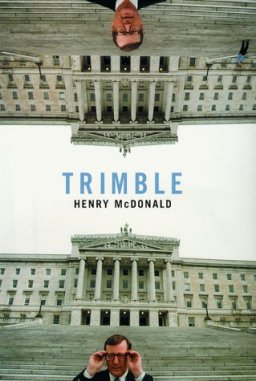
Trimble
Henry McDonald,
London: Bloomsbury, 2000, £16.99
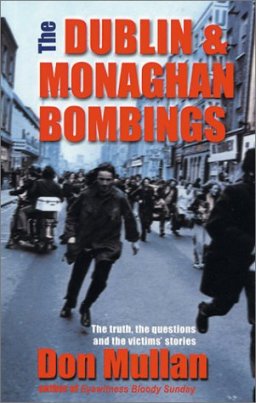
The Dublin and Monaghan Bombings
Don Mullan,
Dublin:Wolfhound Press, 2000, £9.99
David Trimble’s first political involvement began in 1972 when, as a young law lecturer at Queens University, Belfast, he joined William Craig’s Vanguard movement, a hard line right-wing Protestant supremacist organisation that made clear it was ready for civil war to exterminate the republican enemy. He was, for a time, a member of Craig’s private army, the Vanguard Service Corps; but his role was not on the streets. Trimble became a back-room advisor to the Ulster Defence Association (UDA), briefing the likes of Glen Barr and Tommy Herron, on legal, political and constitutional matters. McDonald insists that he ‘was never party to the who, what and why of UDA assassinations’. He kept his distance from the beatings, the torture and the killings. How distant is a matter of debate. When Craig’s Ulster Loyalist Council called a general strike against the abolition of Stormont on 7 February 1973 five people were killed, including a fireman shot dead by a loyalist gunman. As McDonald observes:
‘While Craig, Trimble and their colleagues flirted with the loyalist paramilitaries it should never be overlooked that the latter carried out blatant and brutal sectarian carnage’.
These were the people Trimble was advising on matters constitutional and political without any mention of assassination taking place.
When the Ulster Workers Council general strike took place in May 1974 Trimble was there advising the leadership and coediting the daily strike bulletin. His role in bringing down the previous power-sharing executive is somewhat ironic. After its downfall, he became an advocate of independence for Ulster and early in 1976 was appointed deputy leader of Vanguard. When the movement finally collapsed in 1978, he joined the Ulster Unionists, a member of its intransigent right-wing.
Throughout this time he continued to advise the loyalist paramilitaries, particularly during the struggle against the Anglo-Irish Agreement of 1985. He once again became an advocate of independence and, apparently, his closeness to the paramilitaries alarmed some in the Unionist leadership. According to Mc-Donald, Andy Tyrie has confirmed that at this time he and John McMichael would seek out Trimble for political guidance. McMichael and Trimble belonged to the same Apprentice Boys’ Club in Lurgan and would have met on the Ulster Clubs’ Grand Committee, too. However, they also saw each other outside these institutions. Tyrie recalled that in late 1986 he and McMichael often went to Trimble’s home.
McDonald sees this relationship as lying behind the allegations regarding Trimble in Sean McPhilemy’s The Committee, but he is justifiably sceptical of the book, referring most tellingly to the loyalist paramilitaries’ deep distrust of the Unionist establishment. Nevertheless it is clear that at this time Trimble was once again contemplating civil war, the repartition of the North and a ‘Beirut style’ situation.
What led to his transformation into peacemaker? The key, one suspects, is the realisation by the end of the 1980s that the Provisional IRA had been effectively contained by the security forces and were coming under increasingly effective pressure from the loyalist paramilitaries. These two factors led to the Provisionals’ readiness to abandon the armed struggle on the right terms, and seem to have convinced Trimble that a new game was underway.
One should not underestimate the radical nature of his transformation. When James Molyneux stood down as Ulster Unionist leader in August 1995, Trimble campaigned for the succession as a hard liner, boosted by that year’s Orange victory at Drumcree, which he and Paisley had celebrated hand in hand. He defeated the ‘liberal’ candidate, Ken Maginnis, but it seems clear that he had already decided peace on Unionist terms was possible. The problem was not to be the republicans but the Protestant supremacists inside and outside his own party.
While Trimble saw Sinn Fein joining a partitionist government as a historic defeat for Irish republicanism, there were powerful elements within the Protestant community who were completely opposed to power sharing with Catholics on any terms and for whom anything short of the restoration of Protestant supremacy was a betrayal. It was these elements who tried to secure Trimble’s expulsion from the Orange Order for attending a requiem mass for the children killed in the Omagh bombing. They failed to bring the Good Friday Agreement down at Drumcree, the Orange Order’s Groundhog Day; but decommissioning or some other pretext is likely to succeed in the future. McDonald is scathing about the hypocrisy of these people, but at the time of writing Trimble’s long term survival looks very much in doubt. Interestingly, the diehards’ explanation of Trimble’s treachery is that he is an M15 agent!
 One last point of interest: McDonald reveals the identities of a key group of advisers that Trimble has gathered around him. Ruth Dudley Edwards, the historian Paul Bew, Eoghan Harris, who managed Mary Robinson’s media campaign in the 1990 Irish Presidential election, and most important of all, Sean O’Callaghan. O’Callaghan figures in McDonald’s account as an ex IRA man, but perhaps a better characterisation would be ex Irish intelligence agent. He has become ‘a pivotal behind the scenes player’, acting as liaison between Trimble and the loyalist paramilitaries and playing a key role in devising Ulster Unionist strategy.
Henry McDonald’s Trimble is an extremely enlightening book. He has done a fine job in bringing the Ulster Unionist leader and Nobel Peace Prize winner into focus; Trimble is a most unlikely peacemaker with some interesting connections that deserve further scrutiny.
Don Mullan’s The Dublin and Monaghan Bombings is one of the essential books of the Troubles. Deriving from the Yorkshire TV documentary, ‘Hidden Hand: The Forgotten Massacre’, broadcast on 6 July 1993, it shows that there is a strong case that there was an official cover-up in relation to the bombings of 17 May 1974. While David Trimble was busy advising the loyalist paramilitaries on constitutional matters during the UWC general strike, some of their men killed thirty three people in Dublin and Monaghan in the worst bombings of the war. It seems clear from his evidence, that the bombing required covert British involvement and that the reason those responsible were never brought to trial was to conceal that involvement with both the British and Irish governments party to the cover-up. This is a fine book. We are all in Don Mullan’s debt.