
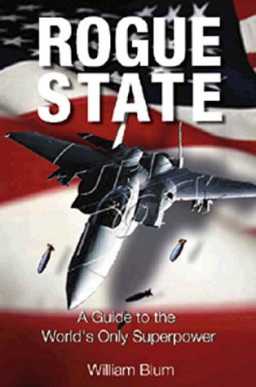
Rogue State: A guide to the world’s only superpower
William Blum
Common Courage Press, Monroe, Maine, 2000, $16.95
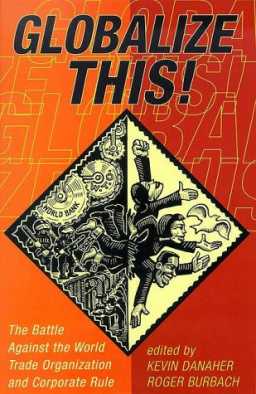
Globalize This! The battle against the World Trade Organization and corporate rule
eds. Kevin Danaher and Roger Burbach
Common Courage Press, Monroe, Maine, 2000, $15.95
I have lumped these together partly because they are both published by Common Courage and partly because they both bear on the same subject, the current American domination of the world. The Danaher/Burback book consists of 26 short essays centred round the events in Seattle at the meeting of the World Trade Organisation; what happened (and what didn’t: media misreporting); why; who the participants were, and what the various transnational organisations do; the political agenda, the background to the Seattle event; and prospects since. If you wanted a single volume with which to start on the current debate about globalisation this would do admirably. Readers who are already au fait with the story may find the brevity of some of the chapters unsatisfactory.
The Blum book is much the more significant of the two. His two previous books, The CIA: a forgotten history (London: Zed Press, 1986) and its revised and expanded version, Killing Hope: U.S. military and CIA interventions since World War 2 (Monroe, Maine: Common Courage, 1995) are among the essential texts of the past 20 years. In this new book Blum has produced a kind of handbook on American hypocrisy, comparing what America actually does in the world with its rhetoric of freedom, human rights and all the rest of the nauseating guff its spokespersons offer us.
Thus Blum first presents evidence of US support for terrorists; assassination as policy; manuals on torture; US support for and training of identified war criminals.
Having laid the general ground, under the heading ‘United States use of weapons of mass destruction’, he proceeds through particular subjects: depleted uranium, chemical and biological warfare; cluster bombs.
Finally, in the third section he offers brisk summaries of his own earlier books (in 43 pages!); the National Endowment for Democracy (NED), the CIA’s former psyops and political action programmes in light drag; surveillance and the Echelon story; the CIA and drug trafficking; and so on.
 In short, Blum has managed a kind of summary – with documentation – of a large chunk of the elements of the radical critique of US foreign policy associated with himself, Edward Herman, Noam Chomsky, Peter Dale Scott, Michael Parenti, Covert Action et al.
Bringing all the elements together, even in these summarised versions, the effect is devastating: this is the most concentrated assault on American foreign policy in a single volume I have read.
Unfortunately, the people who are likely to read this book are those who have already taken all this on board. The people who ought to read this – in this country the naive enthusiasts for the ‘American way’ in the Parliamentary Labour Party, in the media (for example the idiotic Jonathan Freedland) and among the junior policy wonks feeding Tony Blair’s illusions – will not do so.
There is a very telling anecdote at the beginning of chapter 9. Blum rings up ‘the terrorism desk’ at the State Department and asks why Cuba has been included in a list of nations which ‘sponsor terrorism’. When told that Cuba ‘harbors terrorists’ he points out to the flak-catcher on the other end of the phone that the Cuban exiles in Miami, sponsored by the United States, have committed hundreds of terrorist acts. Cue indignant flak-catcher and the end of conversation.
It isn’t clear from Blum’s account whether the outrage expressed by the flak-catcher at the proposal that the US harbored terrorists was real or synthetic. It could be either. Some of those engaged in running the foreign and economic policies of the United States and its flunkies are undoubtedly white supremacists and chauvinists whose basic attitude to the non-white, non-American world is, ‘Fuck ’em’. But my impression is that most are not; most seem to me to be essentially well-intentioned people who believe their own rhetoric and theories; and who sustain those theories by excluding material – such as Blum’s book – which challenges them.
There are plans to publish this in the UK, says Blum, and extracts from it can be read at http://members.aol.com/superogue/homepage.htm.