
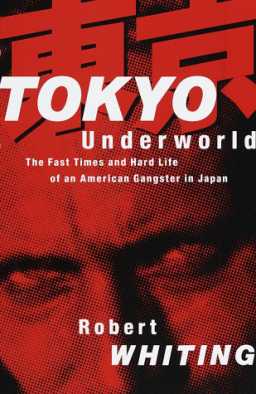
Robert Whiting,
New York: Pantheon Books, 1999. ISBN 0-679-41976-4.
Sergeant Nick Zappetti first arrived in Japan during the late summer of 1945, one of the tens of thousands of US occupation troops who landed there after V-J Day. Unlike most of the others, Zappetti immediately went into business for himself and set up a whorehouse, which enjoyed a brisk trade from his Marine Corps colleagues. This set the trend for the rest of his life, one that was largely characterised by a variety of nefarious doings on the wrong side of the law.
After several months additional military service, Zappetti was honourably discharged but decided not to return to the limited opportunities awaiting him back home in New York City. The lure of staying on in Japan, as author Whiting explains, ‘where the choices for someone with brains and a larcenous heart’ were so good he simply could not bring himself to leave.
Zappetti’s new civilian career began with pilfering the bounteous US military stores of scarce commodities such as salt, soap and cigarettes and then selling them on to the Yakuza (Japan’s answer to the Mafia) who managed the post-war black market. Among many other things, he later moved on to manage, at $500 a match, the hugely popular (and blatantly fixed) wrestling tournaments that featured diminutive Japanese contestants roundly trouncing vastly larger and more capable American rivals.
Oddly enough, Zappetti nearly always succeeded in eluding the best efforts of the Japanese police to close him down. Indeed, not only did he prosper, thanks in part to a lucrative and uncharacteristically legitimate chain of pizza parlours, he also became one of the very few Westerners to gain Japanese citizenship. He also went through a series of four Japanese wives, with three marriages followed by messy and expensive divorces. These marital troubles, combined with some faulty business decisions, meant that when Zappetti died in 1992 he had lost most of his fortune.
The story of Nick Zappetti’s criminal career alone is fascinating and entertaining enough to justify reading this book. However, its scope extends far beyond the career of one expatriate gangster. Whiting, a reporter who is also a long time Japanese resident, goes on to depict aspects of the country largely unknown to foreigners and, one strongly suspects, probably most Japanese as well.
This is a Japan, as Whiting describes in abundant detail, made up of ‘gangsters, corrupt entrepreneurs, courtesans, seedy sports promoters, streetwise opportunists, intelligence agents, political fixers and financial manipulators’. More to the point, he also traces the history of the complicated entanglement of the US government, or more specifically the CIA, with the Liberal Democratic Party, which has governed virtually non-stop from when Japan regained its independence in 1952 until the present day. The CIA was still funnelling up to $1 million per month to the LDP as late as the 1970s.
Altogether this was and remains what Whiting calls a ‘bizarre demimonde’, one which illustrates the ‘greed, arrogance, duplicity and revenge that spans fifty years and bares many hidden layers in the US-Japan relationship.’ And in Nick Zappetti he has found an apt symbol of that relationship.