
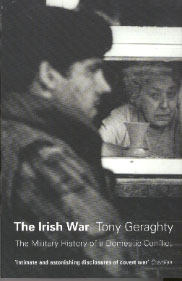
Tony Geraghty
Harper Collins, London 1998, £19.99
Before dawn one Thursday in December 1998 a team of six Ministry of Defence police raided the home of the writer and journalist, Tony Geraghty. After seven hours, they left taking his computer, modem, disks and work in progress, having charged him under Section V of the Official Secrets Act of 1989. According to one early press report, a former Army officer, Lieutenant Colonel Nigel Wylde was also arrested at his home in Esher. What provoked this demonstration of New Labour’s commitment to freedom of information? Geraghty’s latest book, The Irish War.
At first sight, Geraghty is a most unlikely target for the secret state. He is the author of the best-selling Who Dares Wins, a popular history of the SAS that played a major part in creating that regiment’s overblown myth. More recently, he published Brixmis: The Untold Exploits of Britain’s Most Daring Cold War Spy Mission, hardly a subversive work! His forte has been listening to covert warriors’ stories (including their complaints!) and turning them into popular history. It is this that seems to have put him in the frame.
Certainly he was aware that he was negotiating dangerous terrain. His publisher had been approached by Rear Admiral D. M. Pulvertaft, secretary of the Defence Press and Broadcasting Committee (the ‘D’ Notice Committee), for a pre-publication view of material relating to the SAS. Harper Collins refused. In retrospect, Geraghty told the Observer, ‘its probable I had been under surveillance for some months’. He had some intimations of trouble and ‘got on with the normal, end-of-book weeding of files with more than usual urgency’. What had seemed like paranoia at the time, after the raid ‘became prudence’. He now assumes that his home and his telephone are bugged.
‘Suddenly I was learning what it was like to live inside the electronic cage evolved for use in Northern Ireland and, as my book reveals, up and running, and ready for use in Britain.’ (Observer 3 January 1999)
There is considerable irony in such a strong although not an uncritical supporter of the secret state falling victim to it, but this does not excuse what seems to be an attempt to financially ruin him and, in the process, scare off others.
What of the book? It has the appearance of being quite hastily put together with the first 244 pages covering the contemporary Troubles, but tacked onto the end another hundred odd pages providing a Cook’s tour of Irish revolutions and revolutionaries. This extended appendix is of little value. The book also contains some clumsy factual errors: for example, the bombing of McGurk’s Bar was not, as Geraghty claims, ‘an IRA own goal’; and the Civil Rights movement was certainly not ‘a classic of Republican political deception’. Nevertheless there is much of interest in the main body of the text.
Geraghty’s account of the early years of the war provides further reinforcement for what has become the accepted view: the Army’s counter-insurgency methods were completely inappropriate, and rather than containing or suppressing the conflict, actually exacerbated it. He does not mince his words:
‘When street violence boiled over, Northern Ireland was treated as just another rebellious colony to be punished accordingly. This policy would prove to be the IRA’s most able recruiting sergeant.’
The imprisonment of Bernadette Devlin for helping defend the Bogside was ‘an error of epic proportions’, while none of the RUC ‘thugs’ who had been attacking the area were prosecuted. Crucial, however, was the Falls Road curfew, which Geraghty had covered first-hand as a young reporter. He describes one incident:
‘The soldiers half-carried, half-dragged a dead body from the direction we had come and let it drop heavily on the greasy pavement. Then they took turns to kick the corpse and curse it. They thought they had killed a terrorist, but the victim was more enigmatic and interesting than that. He was, almost certainly, Zbigniew Ugilik, a Pole who had been working in West London until the day before. Then, for no obvious reason, armed with expensive camera equipment, he flew to Belfast to take photographs. In the gloom, a camera with a long lens can seem like a gun as it is pointed over a wall. The chances are that he was working for British Intelligence.’
Geraghty forthrightly condemns the Heath Government’s hard line policy, providing the fascinating detail that senior ministers had urged ‘an unlawful “shoot-to-kill” policy’ on the Army, but had been turned down. Lord Hailsham had apparently advised the generals that the troops in Northern Ireland could quite legally shoot anyone who so much as obstructed them, but Field Marshal Carver rejected this doctrine. Those occasions when the troops did shoot down unarmed civilians only increased support for the IRA.
More controversial is his account of the war after 1975, when it ‘mutated into a form of warfare that would defy previous analysis.’ A long-term strategy of containment and attrition was adopted with what he describes as a ‘Soft War Machine’ constructing ‘an invisible cage of electronic and human surveillance….. around selected homes and neighbourhoods.’ I presume that it is the detailed account of this invisible cage that he provides in Chapter 9, ‘The Eyeball, the Eavesdrop and the Judas Kiss’ that was, at least the ostensible cause of his arrest.
He provides a somewhat sanitised account of agent-running (the Brian Nelson affair gets very cursory treatment), but has more to say about electronic surveillance. Computers are the ‘collating brains’ for this new type of warfare with the Army in Northern Ireland running ‘Vengeful’ for vehicles and ‘Crucible’ for people. According to Geraghty, surveillance capability has actually been stepped up since the ceasefires and extended to Britain. This is all supported by quotation from what one presumes are classified documents. ‘Surveillance cameras around sensitive areas such as the City of London’, we are assured, are ‘linked to computers which will automatically identify suspect vehicles within four seconds’. Moreover, these have ‘evolved into computerised digital maps of human faces.’ Perhaps this information and where it came from has rattled some cages.
There is another possible explanation for the crackdown on Geraghty. He argues quite strongly that the war in Northern Ireland is not really over, that the IRA is repositioning itself for another round, and that the security forces must be ready for this. I suspect that this interpretation of developments comes from the same sources as provided the details of electronic surveillance. It seems likely that the raid on Geraghty was intended to silence those elements in the security services opposed to current Northern Ireland policy as much as to maintain the secrecy of Big Brother’s watchers. Geraghty might be the unwitting victim of a feud within the security services.