
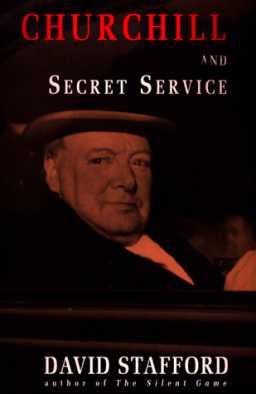
David Stafford,
John Murray, London, 1997, £25
Any book dealing with Winston Churchill must situate itself within one of two rival camps. On the one hand, there are the Churchillians, who regard him as one of the great men of the twentieth century, who dominates modern times and deserves personal credit for having saved Britain from defeat in the Second World War and the world from Nazi tyranny. This is still very much the dominant viewpoint and forms one of the cornerstones of conservative ideology in post-war Britain.
The Churchill myth allowed the Conservative Party, much of which was tainted by appeasement, to confiscate the Second World War and make it their own. This process has continued down to the present day with the likes of Margaret Thatcher, who, having singularly failed to contribute to the war effort at the time, nevertheless subsequently adopted an ersatz Churchillian guise for political advantage. Martin Gilbert’s massive multi-volume biography is an overlong statement of this camp’s position.
The interpretation of the other camp reduces Churchill in size and places him firmly in historical context. From this point of view, Churchill appears as someone from an exceptionally privileged background, who always regarded himself as one of Britain’s natural rulers and took for granted that he should play a great role in history. He was always a political opportunist, encumbered with very little principle, becoming increasingly reactionary from about 1912 onwards. He was, as far as his political colleagues were concerned, a byword for bad judgement, unreliability and downright treachery – a political adventurer who was not to be trusted. Only the outbreak of war in September 1939 saved him from going down in the history books as a political failure who had ended his career as the embittered leader of the reactionary right wing of the Conservative Party.
When the Chamberlain Government was brought down by the Norwegian fiasco (for which Churchill was primarily responsible!), he only succeeded to the office of Prime Minister at the insistence of the Labour Party, who refused to serve under Chamberlain’s candidate, Lord Halifax. This was an historic choice because Halifax would certainly have made peace. Nevertheless Labour’s crucial role has been forgotten. Once installed in power, Churchill ensured that all the propaganda resources of the state were devoted to making him synonymous with the British war effort, an exercise that was often bitterly contested at the time, but triumphed once the war was over. Churchill’s own six volume history of the Second World War has seriously distorted British understanding of that conflict. A good case can be made that throughout the war virtually every operational decision that he was able to influence was wrong, with often disastrous consequences. Britain only just held on until the Soviet Union and the United States won the war.
The choice for historians is really whether they place a reduced Churchill in context or whether they, in effect, ‘Churchillise’ the context. Where does David Stafford stand in all this? While not an out-and-out Churchillian, nevertheless what we have in this volume is the discovery that Churchill was one of the architects of the British Secret State. He played, we are informed, ‘a far more important and active part in the creation of Britain’s modern intelligence community than is generally recognized’; and, moreover, his ‘lifetime shadow war’ in defence of British interests, culminated with Operation Boot, the overthrow of Mussadiq in Iran.(1)
What we have here is a ‘Churchillised’ history of the Secret State. While Stafford’s general thesis is unconvincing, the book does throw some interesting light in murky corners.
Even when he was still a minister in the Liberal Government before the outbreak of the First World War, it was Churchill, we are assured, who, as Home Secretary, first authorised the clandestine interception of mail through general warrants and chaired the committee that spawned the 1911 Official Secrets Act. Stafford recounts the quite disgraceful story of how the Official Secrets Act was foisted on the British people by the Liberals. Worried that such an ‘illiberal and draconian measure’ might encounter difficulties in the Commons, rather than introduce it himself as Home Secretary, it would be presented at some appropriate time by the Secretary of State for War (Seeley), dressed up as an urgent national defence issue. The opportunity came at the height of the war scare generated by the Agadir crisis in the summer of 1911. The Bill was rushed through its second and third readings in half an hour on a Friday afternoon when the House was virtually empty…… No bill, Seeley later observed with satisfaction, ‘had ever before passed through all its stages in one day without a word of explanation from the minister concerned.'(p. 35)
Stafford’s perpetuation of the Churchill myth is perhaps best exemplified by his celebration of Churchill as the creator of Room 40, the Admiralty’s sigint operation. Churchill was, indeed, First Sea Lord when Room 40 was established and took a close interest in signals intelligence; but the reality is that whoever had been First Lord at the time, Room 40 would have been established. Much more notable was Churchill’s continual interference in its running.
Predictably, he was an eager victim of the ‘spy mania’ that gripped the country on the outbreak of war in 1914, actually leading a raid, pistol in hand, on the home of an unsuspecting Tory MP in Scotland!
One aspect of Churchill’s politics that Stafford usefully identifies but does not explore in enough detail, is the way that this increasingly conservative, not to say reactionary, figure, who championed a strong state, had a life-long fascination with secret agents, assassins, revolutionaries and guerrilla fighters. From Sidney Reilly and T. E. Lawrence through to Fitzroy Maclean and Orde Wingate, Churchill enjoyed the company of such men, listening to their stories of secret operations, of murder and mayhem, and narrow escapes. Certainly this reflected a romantic streak in his intellectual make-up, but it also represented a belief that sometimes the security of the Empire required the services of adventurers who were not bound by conventional rules, men who could undertake the dirty, deniable, work best carried out in the shadows.
This tendency was at its most grotesque during the Irish War of Independence when Churchill was responsible for the activities of British death squads in Ireland. Police and soldiers in plainclothes were used to assassinate members and sympathisers of Sinn Fein. Churchill took great delight in hearing about these activities first-hand, much to the disgust of the Chief of the Imperial General Staff, Sir Henry Wilson. If this had become public knowledge at the time it would probably have ruined him, but historians take a much more generous view of such minor misdemeanours.
The Bolshevik menace
Churchill’s great obsession during the early post-war years was the threat of Bolshevism. Stafford provides an interesting account of his instigation of an attempt to destroy George Lansbury, a left-wing Labour politician and future leader of the Labour Party. A committed opponent of British intervention in Russia and critic of Churchill’s prosecution of that policy, Lansbury visited Russia in 1920. There he met some prisoners-of-war, giving rise to rumours that he had incited them against the British Government, urging them to mutiny. Churchill instructed the Director of Military Intelligence, Lieutenant-General Sir William Thwaites, to prepare a case against Lansbury with a view to prosecuting him. The man Thwaites put in charge of this was the ubiquitous Major Joseph Ball, the man who was to run ‘dirty tricks’ for the Conservative Party throughout the 1920s and 1930s. But while some of the recently returned POWs could be persuaded to incriminate Lansbury, others persisted in denying that any such episode took place. A prosecution was not possible so it was decided, instead, to leak just the incriminating material to the appalling Horatio Bottomley MP, for publication in his patriotic newspaper, John Bull.
‘Flirting with treason’
At much the same time as he was trying to frame Lansbury for treason, Churchill was himself coming close ‘to flirting with treason’. Churchill appeared to endorse Sir Henry Wilson’s fantasies about a military coup to overthrow Lloyd George and establish a government committed to a crusade against Bolshevism. While he backed away from Wilson’s intrigues, what is significant is that he never squashed them which he was surely bound to do as Secretary of State for War.
Stafford has some interesting things to say about Churchill in the late 1930s. He dispels the myth that Churchill was given access to intelligence material with the connivance of Chamberlain’s government despite his opposition to the policy of appeasement. Instead, Chamberlain and co. did their best to stop the leaks, threatening to prosecute Churchill’s son-in-law, Duncan Sandys. There can be no real doubt that Churchill was in serious violation of the Official Secrets Act.
The book covers a number of issues relating to the Second World War. The importance of Ultra, the activities of SOE, Churchill’s attitude towards MI5, the close cooperation between the British and Irish secret services, the assassination of Admiral Darlan and the rise of the Anglo-American intelligence alliance are all covered. This is, by and large, well trodden territory.
As for the post-war period there is the revelation that the European Movement was only kept afloat by funds that Churchill solicited from the Americans: Sandys urgently requested £80,000 to keep it solvent. The CIA funds, channelled via Donovan and Dulles, prevented its collapse during the first two decisive meetings of the Council of Europe at Strasbourg in 1949 and 1950. But Churchill and Sandys kept knowledge of the source of their money confined to a small circle. As for Churchill’s encouragement, once back in office, of the Anglo-American operation to overthrow Mussadiq and instal the Shah as an absolute monarch, this was, Stafford tells us, ‘a fitting finale to the career of this Victorian man of action’.
What we have here is another example of the exaggeration of Churchill’s role because there can be little doubt that Operation Boot would have gone ahead even if Labour had been returned to office in 1951. This illustrates the problem with the whole book. While Stafford has many interesting things to say, he has effectively surrendered to the Churchill myth. What we have here is a Churchillian history of the Secret State that glorifies both the man and the institution.
Notes
- Newsinger’s Mussadiq is my Mossadeq. There appears to be no concensus on this – ed.