
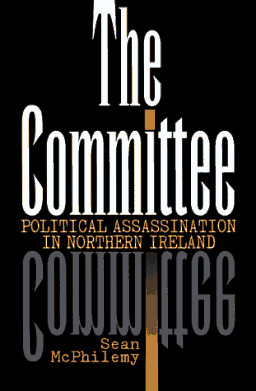
Sean McPhilemy
Roberts Rinehart, Boulder, Colorado, USA, 1998, $24.95
Sean McPhilemy was the producer of a Channel Four documentary, ‘The Committee’, shown in 1991, which made a series of startling allegations about collusion between the Royal Ulster Constabulary (RUC) and Protestant paramilitaries in Northern Ireland in the killing of Catholics. The programme — which I don’t remember — apparently claimed that the 1985 Anglo-Irish Agreement between the Thatcher Government and that of the Irish Republic convinced significant sections of the Ulster Protestant community that they were going to be sold down the river. This realisation, it is claimed, transformed the hitherto fragmented Protestant political and paramilitary community into a cohesive, province-wide, secret organisation, the Ulster Central Coordinating Committee. This worked with an ‘Inner Force’ which had formed inside the RUC. The Inner Force supplied intelligence on IRA members and sympathisers to ‘the Committee’, who directed assassins to chosen targets with protection provided by the ‘Inner Force’. This book is about that documentary, its thesis, and the aftermath.
On the central allegations about ‘the Committee’ and the ‘Inner Force’ the author has not really made his case. When Channel Four transmitted the film in 1991 he had one anonymous witness who claimed to be a member of said committee and a little corroborative material. In 1998 he has a little more of the latter; but he still has the same solitary witness, who has since recanted – under pressure, no doubt – and dropped out of sight. This does not mean the story is false. But the evidence is inadequate – as it apparently was at the time the film was broadcast. A friend of mine remembers it as an anonymous, disguised figure making allegations about unidentified people – one of the oddest programmes he has ever seen.
The single most striking thing about McPhilemy’s story is his neglect of much of the context in which this alleged conspiracy was said to be taking place. In 1987 Brian Nelson, working for the British Army, had returned to Northern Ireland, rejoined the Ulster Defence Association (UDA), and become its so-called Director of Intelligence. For more than two years Nelson worked with a British Army unit, the Force Research Unit,(1) to target IRA members for UDA assassins, using the intelligence of the British state. In 1989 the Protestant paramilitaries began flaunting their access to British intelligence files – even fly-posting photocopies of files on walls – forcing the British state to launch an official inquiry, led by John Stevens, Deputy Chief Constable of Cambridge. Although the British Army initially concealed the Force Research Unit’s existence from him, Stevens identified Nelson by his fingerprints on some of the Army documents in the possession of the UDA, and moved to arrest him. On the day before he was to be arrested in January 1990, Nelson fled to England and the Stevens inquiry office was torched. Eventually Nelson was caught, tried, convicted (but praised by the judge), and given a light sentence; his British Army ‘handler’ was given a gong; the section of the Steven’s report on Nelson et al suppressed; and the whole episode pretty much forgotten by all but the IRA and its supporters(2) until the leak to the Sunday Telegraph of 29 March 1998 which revealed the existence of the hitherto virtually unknown Force Research Unit. (McPhilemy may have gone to press before the Telegraph revelation.)
The Ulster Central Coordinating Committee – ‘the Committee’ in the book’s title – was formed in 1986, but was ‘in operation’ – allegedly organising killings – from the summer of 1990: i.e. six months after the arrest of Brian Nelson. McPhilemy’s researcher made contact with the source of the allegations, James Sands, in May 1991 (Sands refers at one point to his group receiving some of the Nelson information). Less than a year into its apparent operational phase, the alleged Committee member James Sands spilled the beans to a British TV company. It appears to me that at the end of the UDA-British Army partnership in the targeting of Republicans, the group calling itself the Ulster Central Co-ordinating Committee made a bid to step into the breach and continue the killing of Republicans (or Catholics, when no Republican could be found), using official intelligence.
McPhilemy describes how Sands, his informant on ‘the Committee’, had already been giving information about it – though not about its alleged role in assassinations – to a Belfast journalist, Martin O’Hagan, who was publishing it in the Sunday World. Setting out to investigate allegations that the RUC was colluding with Protestant paramilitaries in the murder of Catholics, McPhilemy’s researcher on the programme made contact with O’Hagan who put him in touch with his source, Sands.
Asked why he was telling the TV people this story, Sands replied,
‘….there’s thinking within the Ulster Central Co-ordinating Committee that the time is now right for to go public or to let people know that there is someone in Ulster who is fighting for the Ulster cause’ (p. 59)
Sands was seeking publicity for his particular organisation in the struggle for position in the fluid political situation in Northern Ireland at the time.
That the Ulster Central Co-ordinating Committee existed doesn’t mean it had the power its spokesman, Sands, claimed for it; that RUC personnel were colluding in the murder of Catholics doesn’t mean that the RUC ‘Inner Force’ was as big or as powerful as Sands claimed it was; and it may simply be that Sands was exaggerating his group’s significance.
This is the view of Malachi O’Doherty in a review of the book in the generally Protestant-oriented Belfast Telegraph on 8 June 1998:
It is a story that has little realistic sense of the scale of events in Northern Ireland. It is wholly implausible that a Committee such as McPhilemy describes is in operation, or that many of the people involved in it could wield anything remotely like the power he attributes to them.(3)
This seems plausible to an outsider like me: none of the major figures on the Committee identified by McPhilemy have figured in the so-called peace process, for example. But before the discovery of the Masonic lodge P2 in Italy, who would have believed that Licio Gelli was of such significance?
If McPhilemy does not have the story of the decade – at least does not have the evidence to stand it up – what he does have is an important account of a series of attempts by the RUC, using friendly UK media, notably the Sunday Times and the Sunday Express – the usual suspects – to discredit his programme. This section, roughly the second half of the book, is very instructive indeed, describing very clearly how the state co-opts the media to run its disinformation. Eventually McPhilemy sued the Sunday Express and won, costing the Express about £500,000.(4) In October this year he began libel proceedings against the Sunday Times. The reputations of Barry Penrose of the Sunday Express and Liam Clarke of the Sunday Times should be terminally damaged by the material in this book – but they won’t be, so degraded are the standards of British journalism.
The irony here is that had the RUC not made such strenuous efforts to discredit the programme, McPhilemy would have been left stranded without much evidence. But the more the RUC and their tame journalists worked against him, the more he became certain the Sands’ allegations were true.
I remain unconvinced of that: McPhilemy still does not have the evidence to justify the publication of the names of the alleged Committee members listed at the back of this book; and on what he has presented here the $100 million libel suit begun against him in the USA earlier this year by two of those names must have a chance, though US libel laws differ from the UK’s.(5)
It might all be true but the evidence remains no more than suggestive.
The Committee can obtained through Internet bookshops. I got mine through amazon.com; and using the cheapest from of delivery, it cost $23.42 in all – about £16.00 – less than the advertised cover price.
Notes
- Revealed recently in the Sunday Telegraph. See Lobster 35. In his 1992 Big Boys’ Rules (Faber and Faber), Mark Urban referred to the unit as the ‘Field Research Unit’ (p. 216) – and no-one noticed its significance.
- See, for example, the 1993 (?) pamphlet British Intelligence, Brain Nelson and the Rearming of the Loyalist Death Squads. This has no publisher and no date but an intro from Gerry Adams dated January 1993. More recently, see ‘Inside the dirty war: Brian Nelson, British intelligence and the murder of Pat Finucane’, Niall Stranage, Socialist Lawyer, Summer 1998
- Reviews of and news about the book and the various law-suits it has attracted are at http://www.geocities.com/CapitolHill/Senate/5503/press.html. The reaction of the press in Northern Ireland, even the nationalist Sunday World, has ranged from the sceptical to the down-right hostile. As Harry Irwin pointed out to me, even the Sinn Fein/IRA have made nothing of the book’s allegations, suggesting they don’t believe them. Only Saoirse, the journal of the splinter group, Republican Sinn Fein, based in Dublin, has reprinted McPhilemy’s list of the Committee’s alleged members; and even they didn’t make very much of it.
- In these situations, where a newspaper has to shell out big bucks for doing the state’s dirty work, does the state compensate the paper?
- See ‘£60m libel suit in US by Ulster Brothers’, Guardian 12 June 1998.