
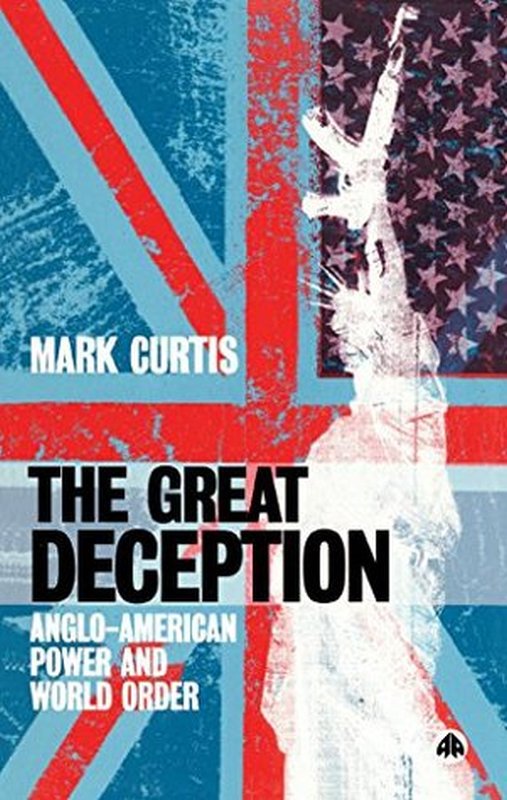
Mark Curtis
Pluto Press, London and Sterling, VA, USA, 1996, £45 hb, £14.99, pb
One of the most intellectually interesting areas I have read through is the debate on the origins of the Cold War between the orthodox establishment apologists for ‘containment of communism’ and the so-called Cold War revisionists like Williams and Kolko, who tried to show that anti-communism was simply a rationale for US imperialism and power. I thought the revisionists made a convincing case but absolute certainty in diplomatic history is impossible: events and the words of the players can be interpreted in different ways. Curtis takes as his starting point the fact that while the ‘communist threat’ has disappeared, the actions of the US and its major flunkey, the UK, remain unchanged. In other words, whatever the diplomats at the time thought they were doing, the Cold War revisionists have been vindicated: it was not about containing communism at all; it was about American expansion, imperialism and capitalism (with declining Britain clinging to its coattails).
At one level this book is reminiscent of reading a mixture of the Cold War revisionists plus some of the 1970s critiques of the institutions of the US-dominated world order, the World Bank, GATT and the IMF, such as Teresa Hayter’s Aid as Imperialism (Penguin 1971) and Cheryl Payer’s The Debt Trap (Penguin 1974). Curtis’s analysis of the areas covered by these earlier books benefits from having access to official documents which were not available in the early 1970s, and his accounts of so-called development, the world economic order and its US-dominated institutions is the more telling for it.
But the major difference between the earlier critiques and his is that where those books largely ignored the British role, Curtis does not. He thinks Britain is important.
‘The idea that Britain is a bit player on the world stage, a mere European power, and is not greatly responsible for what happens in the world, does not accord with the evidence. Britain is one of a handful of world powers, one of the five permanent members on the UN Security Council, one of the world’s largest exporters of arms and military training, is a major financial centre, home to many of the world’s most significant transnational corporations and a major source of foreign investment (and thus one of the world’s greatest champions of a horribly unjust international economic order).’ (p. 2)
Curtis’s book does serve as a useful corrective to the view that the Cold War was simply between the US and the Soviet bloc. One of the major criticisms of the US Cold War revisionist historians has been their failure to take enough account of the UK’s role in the first fifteen years of the Cold War when, with its empire and global armed forces, the UK amounted to a good deal more than it does now. But has the revival of the City of London, fueled by North Sea oil and the Thatcher period of high real interest rates, really seen a revival of British imperialism? I think this is over-stating it somewhat. While it is true that, with the US, Britain is largely responsible for the creation of post-war economic order, Curtis overstates its current significance.
It is true that the UK is one of the UN’s five permanent members of the Security Council – but what does the UN amount to? On Curtis’s account, it has simply served to channel international criticism of the post-war American-dominated world into a forum where such criticism can be blocked by the Security Council members’ vetoes.
London is a major financial centre, but that centre is increasingly owned by overseas companies: the long-term effect of the ‘big bang’ in the City has been the selling-off of UK banks and other financial institutions to foreign companies.
The UK does have some multinational companies but only a handful in the world’s top twenty.
The UK has been a major source of foreign investment in the past 20 years but this will diminish as the UK domestic economy continues to decline and North Sea oil revenues dry up.
The UK does export a lot of arms but its position as a major player in the field is under threat and in decline.
Most of all, the UK is no longer a world military power but merely a cash-strapped proxy for the US, dependent upon US weapons systems and intelligence from the US-dominated global surveillance system. (I don’t take seriously recent newspapers stories about the UK creating a defensive missile screen and building – or acquiring – new aircraft carriers.)
He looks at the post-war Anglo-American relationship, and the initial experience of the Labour Government since it took office last year and shows that nothing has changed – because nothing could change. He treats the claims that Labour is running ‘an ethical foreign policy’ with the derision it deserves. Indeed, the author’s derision and contempt is one of the things about the book I enjoyed most. There is so much bullshit churned out by the apologists for Anglo-American power, it is a real pleasure to watch Curtis trash them.
This is the sequel to Curtis’s The Ambiguities of Power, which was reviewed in Lobster 30. Of that I wrote, ‘This is genuine, major league, ground-breaking stuff. Curtis is the closest we have yet produced to a British Noam Chomsky.’ For all that I think he has exaggerated the importance of the UK in the American-dominated world, this new one is equally impressive.