
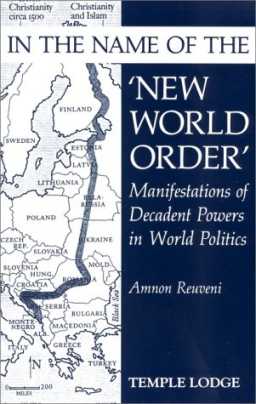
Amnon Reuveni
Temple Lodge Publishing, London 1997, £9.95
The author notes in his Introduction that this was ‘written with the aid of Anthroposophy….and seeks to contribute to a deeper understanding of the post-Cold War world situation.’ The author’s assumptions are listed as:
- ‘The present is not only to he regarded as the outcome of the past;’
- ‘not only political opportunism should be considered but also the spiritual forces working in the background and the groups that attempt to exert an influence over politicians…’
- ‘such groups have a long-term strategy which the politicians under their influence then try, more or less unconsciously, to carry out.’
He also notes that ‘a certain knowledge of the basic written works of Rudolf Steiner…are essential for a true evaluation of the contents of this book.’
I could have stopped at that point, for I know nothing about Steiner; and I’m not a big fan of ‘spiritual forces’, either. But I struggled on. The author appears to believe, rather like some 19th century thinkers did, that the world is the stage for conflicts between occult groups: Masons, Catholics (Opus Dei, I guess) and so forth. The book begins with an account of the rise of Bill Clinton which focuses on the role of the late Averell Harriman and his wife. The author notes Harriman’s membership of the secret society Skull and Bones, at Yale University, and Bill Clinton’s encountering Professor Carroll Quigley at Georgetown University and his subsequent Rhodes Scholarship. To the author this is tantamount to Clinton being inducted into an occult group.
But there is no evidence I am aware of — and none offered here — that Skull and Bones has any content, any ideology, other than secrecy for fun’s sake, and self and group promotion for its own sake. The author sees the Rhodes Scholarships as a manifestation of the Round Table, and the latter as one of these occult groups hidden from history. And his evidence for this? The author describes Arthur and his Knights of the Round Table as if their existence is established fact, then comments:
‘It is difficult to say to what extent the knights of Milner’s Round Table knew of this occult background. But a man like W.T. Stead, who was very close to Rhodes and Milner, and, as both spiritualist and colleague, was well acquainted with Annie Besant, would certainly have been aware of these connections.’ (p. 26)
But which ‘connections’ are there other than choosing the name ‘Round Table’? To offer a mythological figure from British antiquity as evidence for the occult nature of Rhodes’ secret society is absurd. Nonetheless, by these devices the author positions Clinton as, in some sense, the inheritor of an occult tradition, rather than simply as a careerist politician promoted by the Harrimans for the banal reason that to elect a Democratic President in the USA these days you need the votes of the so-called Dixiecrats, and that means picking a Southerner (cf. Jimmy Carter, the prototype).
As the author’s thesis about Clinton is spurious it is difficult to take the rest of it too seriously. However, he appears to believe that a new Roman Catholic geopolitical alliance is being formed in Europe between Germany, France and Poland. He has some evidence to support the view of a Warsaw-Bonn-Paris axis forming; and the idea is clearly not implausible. Poland wants to join the EU and NATO as insurance against Russian imperialism. It is on Germany’s Eastern border and is an obvious target for German capital; and anywhere Germany goes the French will want to go, too. But to posit this as a revival of the Catholic Church’s influence at a point when the church never had less influence in the world, and is rapidly losing ground in its main stronghold, Latin America, strikes me as absurd.