
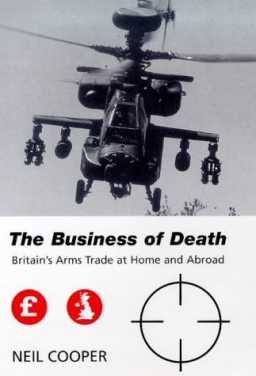
Neil Cooper
I. B. Tauris, London, 1997, £39.50
This is an analysis of the arms business in the UK, chiefly about the MOD’s procurement system. Not a subject I knew much about, I approached the book expecting little. Discovering it had begun as a PhD reduced my expectations even further. In fact it is a fascinating read. If, like me, you had vaguely assumed that the defence sector was a cosy racket involving the MOD and the manufacturing companies ripping-off the tax-payer, you will discover that you were right; and with this book you will have the evidence to back-up your prejudices. Here, with some subheads, are the bits I text-marked on my way through it.
St. Margaret of Grantham
‘In many ways policy on defence procurement, even in the mid-1980s, rested at the epicentre of the contradictions inherent in Thatcherism — between its emphasis on the free market on the one hand and a strong State on the other.’ p. 53
‘Thatcherism’s emphasis on strong defence and the promotion of national economic and security interests has led, if anything, to an intensification of the cosy relationship between the MOD and the defence industry.’ pp. 53-4
Take it, it’s public money
‘….the ministry has also made it clear that as long as some sort of financial restitution is forthcoming and the companies [caught stealing] publicly apologise for their behaviour, they could receive defence contracts in the future. In the long term it seems the companies will receive little more than a slap on the wrist and a request to say sorry.’ p. 95
‘the ministry’s mechanisms for preventing and detecting fraud verge on an inducement to criminal activity.’ p. 172
‘It is notable that while the DHSS set up a telephone hot-line in August 1996 to encourage whistle-blowers to reveal instances of benefit fraud, the MOD has still not set up an independent hot-line for defence company employees to reveal fraud on weapons contracts worth billions of pounds. Instead, it prefers to carry on with a system which does not even claw back the interest earned on excessive profits when they are discovered.’ p. 180 (emphasis added)
The cosiest of cosy relationships
‘…..a leaked printout from an MOD computer revealed that companies who had been the heaviest recruiters of former ministry staff had had the most success in winning consultancy contracts placed by the Department in the previous two years.’ p. 96
‘British Aerospace alone concludes some 2,000 contracts a year with the ministry, and the top 5 contractors account for 31 percent of MOD business.’ p. 178
‘In the two years to 1995, the Conservative Party received almost £1 million from those firms paid £5 million or more by the MOD in 1995-6.’ p. 178
A European defence industry?
‘The risk is, therefore, that any European market that does evolve will simply replicate the protectionism, subsidisation, inefficiency and absence of competition that characterises national markets — a phenomenon Keith Hartley has described as being akin to “all the worst features of the common agricultural policy simply being translated into defence markets.”‘ p. 119
Some exports are worth more than others it seems
‘….the proportion of ECGD export guarantees going to defence projects has increased markedly in recent years. In the five years to 1984-5, just under 10% of export credits went to defence. In the five years to 1994-5, 30 per cent of export credits went to defence.’ p. 139
‘While exports of pharmaceuticals (excluding chemicals) and medical equipment were $2 billion higher than those for defence in 1994, the unit responsible for promoting these exports within the Department of Health has just four full-time staff. In comparison, Defence Export Services Organisation has some 600 staff.’ p. 143
A great British success story (not)
The ‘success’ in selling arms in the Middle East ‘is primarily a function of just one very large contract — the Al Yamamah contract with Saudi Arabia …between 1992 and 1994, UK exports to Saudi Arabia accounted for some $9.4 billion and made up 75 per cent of all British defence exports.’ p. 134
‘….since 1980 the number of domestically generated defence industrial jobs has fallen by 175,000 (amounting to one job for every £51,428 of expenditure).’ p. 159
‘……there is much evidence to suggest that the British Defence Industrial Base has ultimately had a negative effect on growth by depressing investment, diverting scarce R&D resources and by promoting inefficiency in key sectors of the UK economy.’ p. 158
The efficiency of the private sector
- major defence projects behind schedule: 59% in 1989, 95% in 1994
- average slippage in years — 3.1 in 1994
66% of projects more than 2 years late. (p. 168)
Another EU triumph ahead
‘In terms of international security, for example, the cost increase on the Euro-fighter project alone is equal to all of the UN’s expenditure on peacekeeping in 1995.’ p. 177
Guns not diplomats
‘Britain commits the lowest proportion of overseas aid relative to defence expenditure of any state in the EU and has fewer overseas diplomats than either France, Germany or Italy.’ p. 182