
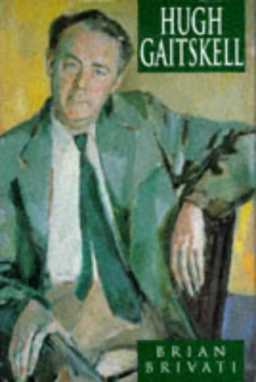
Brian Brivati
Richard Cohen, London, £25
At the height of Labour’s early 1980s challenge to the siting of a new generation of nuclear weapons in Britain, a rising trade union official was invited to the west London home of a former US labour attaché. On the recommendation of a colleague who was active in the Labour Committee for Transatlantic Understanding, he had been proposed for a trip to Washington under a US government visitors’ programme. Sitting prominently on Joseph Godson’s coffee table in Notting Hill was a copy of Philip Williams’ biography of Hugh Gaitskell. It was clear to the young union bureaucrat that his response to the book would have some bearing on his travel plans.
For seven years of Gaitskell’s postwar prominence in the Labour Party, Godson busied himself deeply in British Labour movement from his office at the American embassy. When the Gaitskellite Williams edited the former leader’s diaries, Godson figured sufficiently prominently to earn a pen portrait. And, in a footnote on Gaitskell’s efforts to expel Aneurin Bevan from the party in 1955, Williams records Gaitskell’s apparent concern that Godson was becoming too deeply involved in the party’s internal affairs.
This unsourced observation has intrigued many since it appeared in 1983, but it has failed to stir the curiosity of Gaitskell’s latest biographer, Brian Brivati. Not only does the footnote not rate a mention, but the anti-Bevan plotting at the Hotel Russell to which it relates is described without Godson’s participation.
This is not an isolated omission. In the context of his times – highly organised, well-resourced ‘anti-communism’ by the British and American states – we should expect something substantial on the network of which Gaitskell was the leading British public figure and the activities of the circle around the CIA-funded Congress for Cultural Freedom (CCF) in which he was a prominent participant. On the former, on which there is now a good deal of published material, we find scarcely anything in Brivati. Though he heads a chapter on the 1954-55 internal party battles ‘Dirty Work’, we get no idea just how murky this actually was. For example, we know that Gaitskell worked closely with National Agent Sara Barker, but we are told nothing on how she came by the detailed information on members she kept in her bulging files. Indeed, in the whole book Ms Barker only receives passing mention during his chapter on the Campaign for Democratic Socialism, a much later development in Gaitskell’s battle with the party left. Of how Gaitskell’s efforts linked with his allies in the party, the union movement, the Information Research Department, Common Cause and the rest of the ‘anti-communism’ apparatus, we are told nothing.
Though Brivati quotes from the US Senate 1976 Church Committee report on CIA activity and front organisations, there is similarly no attempt to describe, even less, assess, Gaitskell’s role in relation to American activities during the Cold War. We know from his diaries (and Williams’ helpful pen portrait) that Gaitskell maintained a friendship with Richard Bissell, the senior CIA official who took the rap for the Bay of Pigs invasion. We know from other sources that Gaitskell funded the early days of his Forward magazine with cash from the Jewish Labour Committee, helped by his US trade union and CCF friend, David Dubinsky.
We know that Anthony Crosland, who provided the intellectual underpinning for Gaitskell’s politics and some of his organisational muscle, was paid for a while by the CCF. We know, too, that George Brown, Gaitskell’s deputy, was so close to the Americans as to be described by some as a CIA source. We know that Gaitskell was on good terms with Melvin Lasky, the editor of Encounter and a key organiser of the CCF network.
Yet we learn nothing of the above from Brivati. He does, during his lengthy section on the CDS, write generally about American influence before concluding that CDS did not receive CIA money – scarcely a fresh insight – before adding, unsourced, ‘though if it had been needed, it would have been forthcoming’.
This is thin stuff on Atlanticist ‘anti-communism’, perhaps the central feature of Gaitskell’s career and one which became key to the activities of the ‘Gaitskellites’ who worshipped and organised at his shrine for many years after his death in 1963.
Brivati is more useful on other matters, for example on Gaitskell’s attitude to the Commonwealth, Suez and the Common Market, and he tells us more about Gaitskell’s lively private life than earlier authors. But the overall impression remains one of incompleteness: a biography of a Cold War politician without much serious Cold War history.