
Articles of note
‘Opium, tungsten, and the Search for National Security, 1940-52’, by Jonathan Marshall, in Journal of Policy History, Vol. 3, No. 4, 1991. (Published at The Pennsylvania State University, University Park, PA, USA.)
Marshall is the former producer of the wonderful Parapolitics USA, and, most recently that I have seen, co-author with Peter Dale Scott of Cocaine Politics (University of California Press, 1991). This essay is typically dense parapolitics research, 20 pages, with 107 footnotes. Marshall shows how U.S. forces in the far East, initially in the war against Japan, and then in the desire to secure tungsten, a ‘strategic’ metal, became embroiled in the region’s indigenous organised crime and began what Marshall, after P.D.Scott, calls the ‘government-gang symbiosis……. The common nexus between narcotics, intelligence, ultraright nationalism, organized crime, and respectable politics in Asia has thus had ominous parallels in the United States.’ (p. 461)
This esssay makes a very interesting companion piece to Jeffrey Bale’s esssay on WACL and the Moonies in Lobster 21.
Anybody interested in John Hope’s essay in issue 22 on Maxwell Knight, MI5 and the British Fascisti et al, will want to get a copy of its companion piece, ‘British Fascism and the State 1917–27: a re-examination of the documentary evidence’, in Labour History Review, Vol 57 no. 3, Winter 1992. This is a look at the evidence on the links between the ‘radical right’ groups like British Empire Union, National Citizens Union, British Fasciti et al and the then fledgling British secret state.
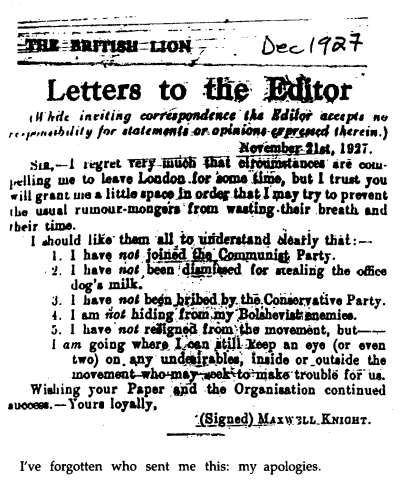
One of Hope’s footnotes refers to a letter from Maxwell Knight published in the British Fascisti’s journal, British Lion, in 1927.
This letter is perhaps the most striking piece of evidence supporting what Hope calls state/fascist ‘collusion’. But ‘collusion’ makes it sound furtive and underhand; and as Knight’s letter shows, the relationship was hardly that. The state — and the secret state — was very much more ramshackle in the 1920s than it is now; and fascism then did not carry the overtones of Hitler and Holocaust. Hope notes that some of the ‘radical right’ were anti-semitic but also notes that ‘tariff reform, a united Empire and patriotic nationalism served as the basis of fascist ideology throughout the inter-war years.’ The same concepts served as the basis of the ideology of much of the Conservative Party in this period. In 1927 it was not difficult see the ‘radical right’ as the continuation of the Tory Party; and the whole a part of a wider, anti-bolshevik, anti-socialist, conservative alliance.
The difficulty with these events of the 1920s is questions like this: How important were groups like British Empire Union? Nobody can be sure at this distance, so differences of interpretation are possible. Not that it matters greatly. As with his earlier essay on this period, this is chock full of fascinating information.