
The Dirty War
Martin Dillon,
Hutchinson, London, 1990.
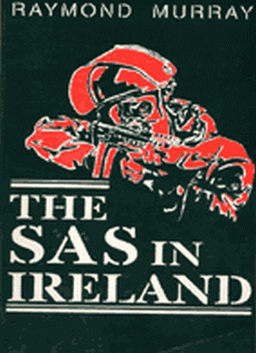
The SAS in Ireland
Raymond Murray,
Mercier Press, Cork and Dublin, 1991
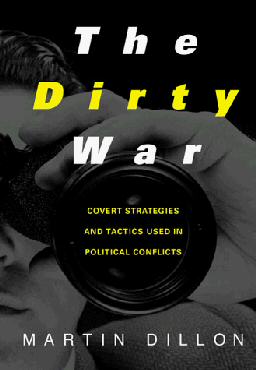
Martin Dillon is a freelance journalist in Northern Ireland with a long career behind him: editor and radio presenter for the BBC in Northern Ireland, co-author of the Penguin Special, Political Murder In Northern Ireland (1973), and author of a biography of Second World War SAS hero Lt. Col. Robert Blair Mayne, and an investigation of Loyalist sectarian killers, The Shankhill Butchers (1989). His book opens with the attempts in 1970 by Captain James Kelly of Irish Military Intelligence to import weapons for the North (Kelly’s books were reviewed in Lobsters 13 and 15) and continues through the history of the Northern Irish conflict up until January 1990. It also covers the international connections of the IRA, in particular their links to Qadhafi, but excludes the Gibralter killings. Dillon sets the tone for his book in the Preface:
‘In the late 1960s and early 1970s, while the conventional forces of government were openly combating terrorism in Ireland, other agencies within the intelligence community in the United Kingdon believed that unorthodox methods and techniques were required in the war. The intervention of these groupings, which included Special Branch, military intelligence, MI5 and MI6, was uncoordinated. Much has been written about that period, some of it honest journalism, but most of it (emphasis added) propaganda inspired by the terrorists and their supporters…. One area of the dirty war which I was obliged to confront was the use of black propaganda by the terrorists as well as the intelligence agencies, and how propaganda led to the deliberate or accidental creation of conspiracy theories. Much of the evidence in print or by word of mouth pointed to the involvement of British intelligence groupings in political murder and the manipulation of Loyalist paramilitaries for counter terror. My conclusions may not please people in both communities or some of the left in Britain, but I believe it has to be said that the vast majority of the conspiracy theories in this regard are inaccurate and in some instances are a deliberate creation of black propaganda for the purpose of discrediting the security forces.’ (pp. xix-xx)
After such an opening statement it comes as no surprise to see Dillon’s dismissive scepticism about British dirty tricks extending to the allegations made by Colin Wallace and Fred Holroyd. Dillon follows the current ‘establishment line’ – fudge on Wallace, slam Holroyd. The key position held by Wallace in Northern Ireland, the mass of documentary evidence he has made available, and the excellent investigation carried out by Paul Foot, has forced the establishment to grudgingly concede that there may be something in what he says. Holroyd, however, is a different case, more easily assailable by his detractors. The attempt to weaken Holroyd’s credibility through claims of mental instability has worked better than sending Wallace down for manslaughter.
Dillon again: ‘I personally feel that much of what Wallace says about the use of dirty tricks is very credible, but that does not mean that everything he says stands up to scrutiny. In his close association with Holroyd, Wallace has not only tended to support Holroyd’s allegations but has provided supportive information. It is in this area that Wallace’s credibility may also be tested, though he may seek to distance himself from Fred Holroyd’s claims in the coming year, if I am right – that gossip about some agents [allegedly killed after a leak from MI5] became ‘ten’ – then there is every reason to examine carefully other claims by both men, because they may have been misled by just such gossip…. I think Holroyd did hear about many secret matters but never fully understood their significance. I believe the explanation for the story of the loss of agents is to be found in a related matter which illustrates how Holroyd pieced together information to create conspiracies….is it a claim he would have manufactured to reinforce his story about the incompetence of MI5? ….One is left with the feeling that Holroyd is either capable of rewriting history to support his conspiracy theory concerning his departure from Northern Ireland, or unable to determine when colleagues were telling him the truth, or else unwilling in this instance to recognize that the statement he says was made by the SAS officer does not stand up to scrutiny.’ (pp. 203-8)
It is true that the story of ten British informers within the IRA being uncovered and executed within a week of the takeover of intelligence work by MI5 needs clarification; Raymond Murray also notes that he can find no record of such a number being killed. An investigation of this report by Holroyd of a claim by Major Keith Farnes, SAS, will not get far, however, if, like Dillon, the investigators are content merely to dish up the ‘poor fellow cracked under the pressure’ line.
Dillon: ‘The collective wisdom in Special Branch circles was that Captain Holroyd was a man of impeccable judgement and commitment. However, that did not appear to be the Army’s opinion of him in May 1975 when he was removed from Northern Ireland…. [and] told to report to an Army hospital in Netley outside Southampton where he spent a month undergoing psychiatric evaluations (p. 193)…I believe that in trying to find reasons beyond his obvious suffering from severe stress he was obliged to construct the conspiracy which eventually placed Nairac at the centre of it (p. 196)…. it is my contention that Wallace saw the value in having Holroyd as a fellow traveller in seeking to attract media attention to his cause…. Holroyd I see as a man who collected scraps of information which he did not always understand and which he often misunderstood.’ (p. 208)
In labouring the point that Holroyd cannot be believed because he was mentally unstable and jealous of Nairac who would take over his job, Dillon makes a series of false or misleading statements. He claims Holroyd spent a month undergoing psychiatric evaluations. Holroyd has strenuously denied that he received any psychiatric examination whilst held at Netley – a denial Dillon chooses to omit, despite Holroyd’s account in his own book. Dillon also quotes extensively from David McKittrick’s September 1987 rejection of the Nairac claim in The Independent, but makes no mention of Duncan Campbell’s rebuttal of McKittrick’s claims in the New Statesman later the same month. The jobs Holroyd held then lost after his return from Rhodesia in 1981 is for Dillon not the sign of MI5 interference with Holroyd’s employment, but further confirmation of his continuing mental instability.
Dillon has many contacts in the Loyalist paramilitary groups, and these lead him to believe that British involvement in murders and bombings has been greatly exaggerated: he claims that most of the attacks allegedly linked to the security forces, such as the Green and Miami Showband killings, were organised purely by Loyalists. It is, however, impossible to judge the veracity of his version, as none of Dillon’s informants are identified. The reader soon tires of finding that ‘evidence’ disproving a British connection to one or other incident is once again unattributed and unverifiable, the reader simply asked to take Dillon’s word for it. It is also frustrating that a professional journalist could produce a book on so complex a subject with totally inadequate indication of published sources. Newspaper articles are referred to only by the year of publication with no footnotes giving either exact date of publication or names of authors and titles of articles. Books are referred to only by titles with no indication of the publisher and no page numbers for quotes; there is no bibliography. In short, the methodology is at best sloppy, particularly for the Wallace and Holroyd cases. (Dillon did not think it necessary to talk to Holroyd before rubbishing him.) Despite these failings, the book is clearly written and contains a great deal of information.
The SAS in Ireland covers slightly different ground to The Dirty War: it does not include the Dublin Arms Trial or the IRA’s weapons sources, but does include Gibraltar and other incidents up to the end of 1989. Its author, Father Raymond Murray, is a leading human rights investigator who has frequently worked with Father Dennis Faul. Murray’s Republican sympathies are clear; however, they do not intrude, and he remains critical where evidence does not definitely support British involvement. Murray may, however, attribute too much to the SAS rather than to other undercover Army units: Holroyd and Wallace’s accounts make it clear that there were several units operating in a disorganised way. Murray’s research is thorough and fully sourced: the book gives the most complete listing of press articles and books on the dirty war yet to be published.
Although it appears to be same size as Dillon’s book, it is in fact nearly twice as long due to the use of a smaller typeface and closer line-spacing. The text is not always clearly written, and Dillon’s book is useful for untangling some of the incidents, but this occasional lack of clarity is more than compensated for by its comprehensiveness. The numerous incidents suggesting the involvement of British undercover units are described in great depth with many eye-witness accounts and excerpts, fully sourced, from a wide range of newspapers, local and national. Those whistle-blowers who have revealed details of British operations (Wallace, Holroyd, Albert Walker Baker, etc.) are discussed in detail. In short, although more of a reference book than a narrative, this is an indispensable source of information for those interested in British covert operations in Ireland.
David Teacher