
STANLEY MAYNE
A Socialist Caucus pamphlet put out in June 1984, Cold War and Class Collaboration: Red Baiting and Witch-Hunts in the Civil Service Unions suggested that ‘A rather mysterious affair occurred in the IPCS (Institute of Professional Civil Servants). Its General Secretary, Richard Nunn, who had in April 1962 correctly realised that the Radcliffe report was an attack upon union activists, suddenly announced next October that he was resigning. He said his resignation was for ‘personal’ reasons. Could it be that Nunn’s opposition to the Radcliffe report brought him into conflict with the IPCS leadership? Was he actually barred under the Radcliffe report?’ (1)
The Radcliffe Committee of 1961 was principally concerned about the Public Service. (2) One result of the Committee’s recommendations was a minor witch-hunt in the Civil Service and its corresponding trade unions. The Committee reported that Communists ‘appear in fact to have achieved a higher degree of penetration here than in almost any other sector of the trade union movement’. The report recommended that ‘Departments should have the right in respect of establishments or staff employed on secret work to deny access to or to refuse to negotiate with trade union officials whom they had reason to believe were Communists.’ This definition was extended to those who were ‘susceptible to Communist pressure.’ Reginald Maudling announced in the House of Commons that the actual number of union officials barred from government departments was a mere seven, (3) though others were moved sideways. Cyril Cooper, General Secretary of the Society of Technical Civil Servants, was deemed a security risk because he had been a member of the Communist party ‘many years ago’. (4)
The flames had been partly fanned by Chapman Pincher during his testimony to the Committee. He reveals in Inside Story (5), ‘I volunteered the suggestion that it seemed rather pointless keeping Communists out of the secret departments when communists or near-communists in Civil Service unions were allowed access. When asked to give an example I cited the case of (Stanley) Mayne, stressing that I had no evidence that he had betrayed any secrets and stating that I did not think it likely that he would ever do so. My main concern was his successor. Mayne had made it plain to me that his successor would be a man of his choice. If Mayne was of the extreme Left the odds were that he would he see to it that his choice was too’. Pincher says that he ‘was told by a former member of the Communist Party that Mayne was not only a card-carrying member but took part in various meetings of party subcommittees.’ (6)
Pincher’s intervention had the desired affect. ‘After he had been in office a little over a year, the defence departments made it clear that they would have no dealings with Nunn. He asked to be relieved of his post, denying that he was a member of the Communist Party or ever had been.’ (7)
Mayne, who died in December 1988, had no doubt been targeted by MI5 throughout most of his career. He had been closely involved in the National Council for Civil Liberties, and in the mid-fifties was Secretary of the Campaign for the Limitation of Secret Police Powers which produced two reports on the activities of MI5. To the probable distress of the Security Services, in May 1976 Harold Wilson made Mayne a member of a committee to ‘review the rules governing the active participation by civil servants in national and local political activities’. (Attlee had set up a similar one under the Chairmanship of his friend Sir John Masterman, the ex-head of MI5’s Double Cross Committee). Barbara Castle reveals in her diaries: ‘On the committee I worked closely with Stanley Mayne … and together we succeeded in edging the committee towards a greater liberalisation of the political activities of civil servants than it would have otherwise proposed.’ (8) James Callaghan, no doubt with Security Service advice, refused to act on it or accept it.
Notes
- Page 9.
- Radcliffe, Cyril John, Viscount. 1961 Security Procedures in the Public Service, Report of the Committee Session 1961-62 Cmnd. 1681 xxvii (HMSO April 1962). The members of the Committee were:
- The Right Hon. the Lord Radcliffe, who served in the Ministry of Information during the War, partly as Chief Press Censor which involved close liaison with MI5;
- F.W.D. Deakin, who had been in the Special Operations Executive and was Warden of St.Antony’s College, Oxford;
- Sir David Milne;
- Field-Marshal Sir Gerald Templer, who had been Director of Military Intelligence in the British Expeditionary Force in Belgium and France; was later head of the Special Operations Executive (German section X), post-war Head of Military Intelligence War Office, Overlord in Malaya, and had headed a similar, but secret inquiry initiated by Attlee.
- The Right Hon. Kenneth Younger. Former Labour M.P. for Grimsby, the constituency ‘handed on’ to Tony Crosland. His cousin William Younger worked for Maxwell Knight as did ‘Bill’s’ mother Joan (Mrs Dennis Wheatley) and sister, Diana. See Anthony Masters, The Man Who was M: The Life of Maxwell Knight (Basil Blackwell 1984) and Nigel West MI5: British Security Service operations 1909-1945 (Triad/Panther 1984)
- The Times 21/2/63.
- The Times 10/6/63.
- Inside Story (Sidgwick & Jackson 1977), p.333
- ibid. p.332
- ibid p.32
- Castle Diaries 1974-76. p.649
KENNEDY McWHIRTER 22/10/23 — 3/11/89
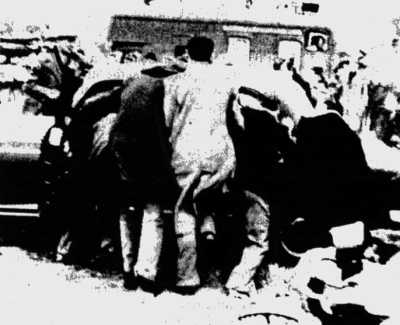
Freedom Today, the newspaper of the Freedom Association published this photograph in its February 1989 issue. It showed, in its view, the violence associated with peace demonstrations. There is, however, a more interesting aspect to the incident portrayed.
Like most people, I suppose, I hadn’t realised that the McWhirter twins had an elder brother, apparently a renowned ‘archeo-linguist’. Although Kennedy seems to have shared their reactionary political views, he remained very much in the shadows. The only reference I know of to his political activities is in The Times, 18th April 1958, which reports what happened when that photograph was taken.
Kennedy and his brother Norris were at the first Aldermaston anti-nuclear march. They were in a car with a loudspeaker demonstrating against the marchers. ‘Marchers! Every one of you is guilty of increasing the risk of war. You are voting with your feet for Soviet imperialist domination’, was the message coming from their car. According to The Times, the car swung into a field where the McWhirters got out and attempted to display some placards. At which point a scuffle broke out with some of the marchers. When they got back into the car people began to rock it. There was some minor damage. The police eventually appeared and managed to get the car out of the field and away from the march.
Later Kennedy told The Times that it was not a ‘political demonstration’. Although he belonged to a political party ‘he declined to say which one.’ ‘I am not frightened of Communist thugs’. He commented on the ‘savage violence’ of the marchers when ‘the opposite point of view was put in words to them.’ Why did Kennedy decline to reveal his political persuasions? Did he have something to conceal?
In 1964 Norris was the Conservative candidate at Orpington. With Ross and Kennedy he was probably a Conservative in 1958. However there is evidence which suggests that they also belonged to another grouping, namely, the League of Empire Loyalists (LEL). George Thayer in his book the The British Political Fringe (1) noted that the LEL ‘being pro-bomb made a habit of harassing the Aldermaston marches.’ A member of the LEL who is now guardian of their records, Rosine D’Bouneviallel, confirms that this particular episode was a LEL stunt. Although she hasn’t confirmed that the McWhirters were LEL members, she has said that they were subscribers to Candou r the paper of the League. (2)
In the opinion of Richard Thurlow, ‘the League of Empire Loyalists was to gain support from both the remnants of the Die-hard tradition, who were dismayed by the collapse of the British empire, and ex-fascists who resented Mosley’s new European idea. In spite of the old-fashioned political tactics its role was to be seminal in the founding of the National Front in 1967.’ Candour was a platform for A.K. Chesterton’s ‘simplistic conspiracy theory’ of Jewish bankers controlling the world. (3)
Notes
- George Thayer, The British Political Fringe: A Profile (Anthony Blond 1965), p.58.
- Thanks are due to N. T. for this information.
- See Chapter 10, Richard Thurlow, Fascism in Britain; A History, 1918-1985 (Basil Blackwell 1987)
MICHAEL STEWART 1906 — 1990
In her diary of the second Wilson Government, Barbara Castle reveals details of a Cabinet Meeting held in early July 1967 to consider the important new White Paper on Defence. ‘Harold began by saying he had had a telegram from (President) Johnson asking us to go slow on defence cuts East of Suez. This was the second time a foreign power had got to know Cabinet business. In these two cases, being the U.S., it wasn’t serious. Nonetheless cabinet business was secret and we should none of us chat about it at embassies and so on.’ (1) The Labour Cabinet apparently had a mole.
Chapman Pincher has written that the Labour Party had been ‘penetrated for many years by agents of the CIA …’ (2) ‘I know the identity of one former Cabinet Minister who was in regular touch with the CIA.’ (3) In what may be a reference to the same person, James Naughtie of the Guardian disclosed that ‘the man … was investigated as a result of an inquiry into phone tapping and was found — to the surprise of ministers who had served with him — to have been a regular informant to Washington.’ (4)
According to David Leigh’s sources the MI5 officer Arthur Martin told friends before his tranfer to MI6 in November 1964, ‘I did hear that —— was a spy.’ An MI5 officer from K branch confirmed to Leigh that ‘We knew that —— was a CIA agent, or, if not an agent, at least very close to the Americans.’ (5) The deletions are in Leigh’s account. The minister was Michael Stewart.
It is unlikely that Stewart was a full blown agent; rather he might be classed as a CIA ‘agent of Influence’. Former CIA covert operations officer Richard Bissell has described how such agents are recruited. ‘The technique is essentially that of ‘penetration’ … the essence of such intervention in the internal power balance is the identification of allies who can be rendered more effective, more powerful, and perhaps wiser through covert assistance … On the whole the Agency has been remarkably successful in finding individuals and instrumentalities which it could work in this way.’ He added that ‘many of the ‘penetrations’ don’t take the form of ‘hiring’ but of establishing a close or friendly relationship (which may or may not be furthered by the provision of money from time to time).’ (6)
In the mid-fifties, according to Chester Cooper, the Labour Party ‘was virtually ignored by the American Embassy during the tenure of Ambassador Winthrop Aldrich.’ But he adds a rider: ‘A few of us, however, tried to provide key Labour Party members with some background on United States policy.’ (7) Cooper was the CIA head of station in the London Embassy. The ‘us’ seems to refer to the CIA and some sections of the State Department. The support was designed ‘so that when they spoke against American moves in Europe or elsewhere, their opposition would at least not stem from sheer ignorance of the facts.’ This isn’t entirely correct since the key people they chose were already very pro-American; and contact went further than mere background briefings.
One of Cooper’s closest contacts in the Party was the Shadow Defence Minister George Brown, whose work ‘brought [him] in touch with various members of the CIA.’ (8) ‘Our relationship’, confides Cooper, ‘was comprised of mutual affection, respect and confidence.’ (9) Brown was also a friend in the sixties of another CIA station Chief, Archie Roosevelt. (10) Both Brown and Gaitskell later received secret briefings from Cooper and Roosevelt on the Cuban Missile Crisis.
This relationship with United States agencies developed when Brown accepted ‘one of the American Congressional Trusts which enabled me to spend six weeks in the United States doing anything I liked.’ (11) The Trust had been set up under the so-called ‘Smith-Mundt’ legislation to encourage suitable foreign ‘leaders’ to visit the States. The Foreign Leaders Programme was designed to educate a new generation of elite managers and was something of a counter-part to the stream of Rhodes Scholars who crossed the Atlantic to Oxford. Michael Stewart was a recipient of the Americans’ largess. In the United States, Brown was ‘able to begin discussions, which I have kept up ever since, with American military leaders and thinkers.’ (12) The same applied to Stewart. It was a cheap way of binding the two elite groups together into the Atlantic community. Those that undertook similar trips to the USSR were often accused of being ‘fellow-travellers’.
A leading member of the centrist ‘Keep Calm’ group in the Labour Party, Stewart went to the United States in the summer of 1954. (13) He most approximated the ideology of the liberal American Democrats, being to the left on social policies but an anti-communist cold-warrior on defence and foreign policy. This was the ideal of the liberal wing of the US elite, and, for example, the CIA. In October 1955 Anthony Jay was a visitor to the U.S. with Hugh Gaitskell, though he was not as enthusiastic as his leader. ‘Contrary to what I had always been taught, it was the basic similarity, despite the obvious differences, between the U.S. and Britain in habits of thought political assumptions, basic education and view of the world. At its strongest, naturally among Washington officials and Harvard academics, this similarity struck me as permeating far wider and deeper than I had been led to expect.’ (14)
The pro-Americans within the Party had their most influence following the internal debate begun in 1958 on the status of the Party’s nuclear defence policy. This had been prompted by the Duncan Sandys defence review of the previous year, which had committed Britain to a reliance on nuclear weapons for its defence. To me (not a Labour Party supporter) the nuclear debate was central to the debate about the nature of the Labour Party, a core position: can socialists be pro-nuclear?
The cold-war warriors of Labour never attempted to develop a left foreign or defence policy, never mind a socialist one. Stewart remained firmly on the extreme right of the party on what were, for the Americans, key policy issues. He even went as far as advocating that ‘in certain circumstances the West should be the first to use nuclear weapons.’ (15) Some years later, looking back at the new policy, which became the foundation of Labour defence policy and the key to its economic policies, George Brown wrote: ‘Our defence must be related to the defence system of the United States. But the Americans will not be willing to keep a large standing Army in Europe indefinitely.’ The later fear over Vietnam was ‘if the Americans were to be kicked out there, a wave of isolationism would sweep the United States, followed by a quick withdrawal from Europe.’ (16)
Stewart turned out to be the most pro-American of all the Gaitskellites, supporting the U.S. involvement in Vietnam right to the bitter end. He had deep personal links with the pro-Vietnam War lobby in the Johnson Administration. ‘Dean Rusk and I … were alumni of St John’s College.’ (17) Stewart was a Callaghan supporter and disliked Wilson partly because of his ‘equivocal attitude during the CND dispute’ … and his ‘hostility to Hugh (Gaitskell)’ (18) Which puts into an interesting light Edward Short’s view that ‘the relationship of Harold Wilson to Michael Stewart during the two Parliaments of 1964-70 was one of great regard and growing reliance — indeed, in the late sixties, as his relationship with George Brown and Jim Callaghan weakened, he probably depended more on his advice than any other minister’s. This was a development which almost everyone in the Government welcomed, for Michael Stewart was a man of considerable wisdom and versatility.’ (19) And, we now know, a CIA ‘Agent of Influence’. Stewart left the Government in 1970 and was later made a peer.
Notes
- (6/7/67) Barbara Castle, The Castle Diaries 1964-70 (Weidenfeld & Nicolson 1984) pp. 273/4
- p.28 Chapman Pincher Inside Story (Sidgwick & Jackson 1977)
- p.159 ibid.
- Guardian 6/5/87.
- p.96 David Leigh The Wilson Plot (William Heinemann 1988)
- Quoted in CIA Infiltration of the Labour Movement (Militant, 1982)
- p.343 Chester L. Cooper, The Lost Crusade: The Full Story of US Involvement in Vietnam from Roosevelt to Nixon (MacKibbon & Kee 1970)
- p.147 George Brown In My Way (Penguin 1972)
- p.343 Cooper op.cit.
- p.469 Archie Roosevelt, For Lust of Knowing: Memoirs of an Intelligence Officer (Weidenfeld & Nicolson 1988)
- p.207 Brown op.cit.
- ibid.
- p.92 Michael Stewart Life and Labour (Sidgwick & Jackson 1980)
- p.244 Anthony Jay Change and Fortune (Hutchinson 1980)
- Michael Stewart, Policy and Weapons in the Nuclear Age, Fabian Tract No.296 (1955)
- p.208 Brown op.cit.
- p.153 Stewart op.cit.
- p.122 Stewart ibid.
- p.33 Edward Short Whip to Wilson(MacDonald 1989)
GREVILLE WYNNE 1919 – 27/2/90
It was interesting to compare the obituaries of Greville Wynne which appeared in the Times (1/3/90) and the Independent (3/3/90). The first gave the standard view of Wynne as a patriot who played an important, and dangerous, role as an intelligence go-between at the height of the Cold War. The success of the operation involving the spy Oleg Penkovsky was, in the view of the Times, a considerable ‘feather in the cap of British Intelligence’. That seems to me to be a fair view of Wynne no matter what your political persuasion, but it wasn’t for Rupert Allason, aka Nigel West.
In the Independent Allason tore into Wynne claiming that he was ‘a Walter Mitty character (the smear he has used against Wallace), fantasising a fictitious life for himself.’ He went on to list a number of these fantasies. The evidence suggests that Allason is in this instance partially correct and that Wynne did indeed embroider aspects of his life. But, the fact remains, Wynne did play a part in what is generally regarded as British Intelligence’s greatest post-war coup. For some reason though, Allason was not prepared to praise Wynne in any way for his role.
There is another obituary which could be written about Wynne. According to Anthony Verrier, with as good MI6 contacts as Allason’s, Wynne was a ‘man of outstanding courage, who also paid heavily for for his service to the State.’ (1) During the Penkovsky operation Wynne played a ‘brave and essential part … acting as the cut-out for verbal communication with SIS.’ (2)
Another writer with what appear to be good contacts is Gordon Brook-Shepherd. His evidence suggests that Penkovsky chose Wynne as his contact man and not the other way round as has been suggested by others. This suited the operation very well because to the Soviets it appeared that Wynne was a businessman they might recruit. For this reason, according to Brook-Shepherd, Wynne never came under suspicion by the KGB. (3) In some ways then, Wynne, somewhat on the sidelines, became an innocent, though no doubt willing, pawn in a complex intelligence operation by British Intelligence. (For instance, Wynne never met the case officers dealing with Penkovsky). And according to Brook-Shepherd, it was Penkovsky who blew Wynne’s name to the KGB. (4)
In his memoirs, Wynne tells us that on the evening of 2nd November 1962 he was holding a small party for commercial representatives in Varosliget Park, in the Hungarian capitol of Budapest. As he walked down the Pavilion steps away from the party two short, thickset men in trilby hats seized him and dragged him shouting and struggling into a Russian built Moskovich car. After a night in a Hungarian jail Wynne was flown by a Soviet military aircraft to Moscow. There he was taken handcuffed to the Lubyanka prison to join his friend Oleg Penkovsky, in an adjoining cell.
With the information now at hand, the events surrounding Wynne’s arrest begin to look distinctly odd. The caravans of the touring exhibition were to be taken via Bucharest by Wynne to a trade fair in Hungary which was to be held from the last week of October. The journey was a purely commercial venture and was not, according to Brook-Shepherd’s sources, anything to do with a Penkovsky escape plan. ‘British Intelligence had been informed of Wynne’s journey and expressed some misgivings’, but ‘it was thought he would be safe in Budapest, where the Russians were unlikely to strike at him.’ (5)
Wynne writes that he made contact with MI6 in Vienna where, he claims, the signal to go ahead to Budapest was given. Wynne believed he was already under surveillance by the Soviets. His own memoirs are not completely clear on this point, but it seems he then went on to Bucharest on the 22nd., only managing to arrive for the last days of the Rumanian exhibition. He remembered arriving just as the Cuban missile Crisis was getting dangerously out of hand. (6) Wynne left for Budapest on 31st. October.
Brook-Shepherd says that Penkovsky’s arrest, ‘though only known to the West on 2nd November, is thought to have been carried out at least a week, and possibly a fortnight, before.’ (7) Verrier claims that MI6 learned ‘within hours’ of Penkovsky’s arrest on the 22nd. (8) So was Wynne deliberately sent on a hopeless mission, sacrificed in some vicious intelligence game? Was there no opportunity in the following eleven days of warning the amateur spy? It would seem that Wynne was to act as a decoy, either to protect the source of the news of Penkovsky’s arrest, or to be the inevitable star at a Moscow show trial drawing attention away from the real agents in (or outside?) the British Embassy. The fact that Wynne openly confessed to the KGB following his arrest, something which Allason gives prominence to, is not significant. No intelligence agent, much less an amateur like Wynne, is expected to hold out for more than 48 hours at which point he/she is free to talk openly.
Wynne paid a heavy price for his patriotism. The imprisonment did certainly damage him and in many ways it is clear that he never completely got over it — a partial explanation for his fantasies and probable alcohol problems. The real spies, the MI6 officers in the Moscow embassy, quietly slipped away protected by diplomatic cover.
Notes
- p.209 Anthony Verrier, Through the Looking Glass:British Foreign Policy in the Age of Illusions (Jonathan Cape 1983)
- pp.213/4 ibid.
- Chapters 9 & 10 Gordon Brook-Shepherd, The Storm Birds: Soviet Post-War Defectors (Weidenfeld & Nicolson 1988). Brook-Shepherd mounts a systematic destruction of Philip Knightley’s version of the Penkovsky/Wynne episode in Knightley’s book The Second Oldest Profession (Andre Deutsch 1986 see pp.313-25), which Brook-Shepherd says ‘averages two factual errors per page.’ (p.284) After the legal problems with his book on the Profumo Affair and the disastrous appearance on the LWT programme on the trial of Hollis, Knightley’s reputation is at an all time low. West’s version of Wynne is to be found in his book The Friends (Weidenfeld & Nicolson 1988). (See pp.123-131) The book was withdrawn following legal action over West’s portrayal of Wynne as an alcoholic etc., but has now appeared in paperback (1990).
- p.156 ibid.
- p.157 ibid.
- pp.198-200 Greville Wynne, Wynne & Penkovsky and p.251 The Man from Odessa
- p.158 Brook-Shepherd op.cit.
- p.224 Verrier op.cit.