
A small section of this appeared in Lobster 12. Although this is incomplete and under researched, we thought it worth putting out now.
The origins of IRD
1947 saw the creation of the Foreign Office’s Information Research Department (IRD). It is generally accepted that IRD was the brain-child of the then Labour M.P. Christopher Mayhew, who had served in one of the ‘secret armies’ (The Phantoms) and the Special Operations Executive (SOE) during the war. The received chronology is that as the result of a paper written by Mayhew to Foreign Secretary Ernest Bevin in October 1947, and with the approval of Attlee, a meeting was called with a trio of the Foreign Office’s senior officials, Sir Orme Sergeant, Ivonne Kirkpatrick and Christopher Warner. (1) In fact IRD’s origins lie elsewhere, inside the Foreign Office.
Warner was a member of ‘the Russia Committee’ of the Foreign Office, set up by him in April 1946 to coordinate policy towards the Soviet Union. On May 7th the committee recognised a need for a ‘defensive-offensive’ policy and drafted guide-lines for a propaganda counter-offensive. Foreign Secretary Bevin, however, was not then convinced such tactics were necessary and Warner’s proposals remained unapproved until November 1947, after the Cominform declaration against the Marshall Plan. Only then did Bevin — and the Cabinet — accept the analysis of the Russia Committee, approving at the Cabinet meeting of January 5th 1948 Foreign Office proposals for anti-communist propaganda operations. (2) Where, in all this, we should now place Mayhew’s October ’47 proposal to Bevin is not clear. Was it a political ‘cover story’, designed to show the initiative coming from within the Labour Government and not from the Foreign Office?
In Bevin’s presentation of the case to the Cabinet on 5th January 1948 he spoke of Britain as a ‘Third Force’: ‘It is for us, as Europeans and as a Social Democratic government, not the Americans, to give a lead in the spiritual, moral and political sphere to all democratic elements in Western Europe which are anti- communist and, at the same time, genuinely progressive and reformist, believing in freedom, planning and social justice — what one might call the ‘Third Force’.’ (3)
The Cabinet accepted the Mayhew-Bevin proposals for a propaganda unit to promote the ‘third force’. Mayhew recognised that ‘since anti- communist propaganda would be anathema to much of the Labour Party, it would have to be organised secretly.’ (4) But his concern was not just with the repercussions within the Labour Party. In a minute to Bevin he commented that, ‘One of the problems that constantly faces us in anti-communist publicity work is to discover publicity media which are definitely non-official so as to avoid undesirable diplomatic and political repercussions when certain issues are raised.’ (5)
IRD worked out of, and owed allegiance to, the Foreign Office, though it often worked closely with MI6’s anti-Soviet Section IX. It used intelligence officers from some of the war-time propaganda agencies like the Political Warfare Executive, and employed a number of emigres from Eastern Europe. There is little evidence that it ever promoted the ‘third force’ concept. Once the politicians’ backs were turned it slipped quite easily into a straightforward anti-Soviet mode. The minutes of a 1950 meeting between IRD officials and their U.S. counterparts show no evidence at all of any ‘third force’ notions. Christopher Warner talks exclusively of anti-communist activities, and refers to the 1948 Cabinet decision to set IRD as ‘authorising anti-communist activities’.(6) Did Mayhew or the Labour Cabinet actually think the Foreign Office would promote the ‘third force’ idea, would actually ‘attack Capitalism and Imperialism as well as Russian Communism?’ (7)
IRD had representatives in all British embassy’s abroad. In the recollection of a former MI6 officer of the period, IRD was involved in ‘some of the more dubious intelligence operations which characterised the early days of the cold war.’ (8) These may have included domestic operations. Mayhew recalls, ‘at home, our service was offered to and accepted by, large numbers of selected MP’s, journalists, trade union leaders, and others, and was often used by BBC’s External Services. We also developed close links with a syndication agency and various publishers.’ (9) The 1950 minutes of the IRD-U.S. talks include then IRD head Ralph Murray’s comment that ‘Trade Union organisations and various groups are used to place articles published under the by-line of well known writers.’ (10)
Freedom First
Trade unions were obviously one source of ‘non-official’ publicity media. The TUC’s International Affairs Department had established a cozy relationship with the Foreign Office in the 1930s (11): channels already existed for the secret discussions between the TUC and the Foreign Office for ‘the dissemination inside the Labour movement at home of anti-communist propaganda.’ (12) One such was arranged through Herbert Tracey, publicity officer of the TUC, who set up an anti-communist periodical called Freedom First. Subsidised by IRD and using material supplied by IRD on a ‘strictly confidential basis’, (13) Freedom First’s circulation quickly rose to 20,000, most of the copies going to Western Europe. (14) Freedom First is the first evidence of the covert nature of the ‘third force’. The anti-communist (and anti- socialist) struggle was to be fought by an alliance of American-influenced trade unions, emerging social democrats with little time for socialism — and allies in the secret world. But this first joint TUC-IRD venture was blown almost immediately, a casualty of the Lynsky Tribunal hearings during the winter of 1948.
The Tribunal had been set up by the government to look into the activities of a Polish emigré known as Sydney Stanley who was alleged to have bribed John Belcher, a Labour M.P. and Parliamentary Secretary to the Board of Trade. Headline news in the Tory press for several weeks, the case looked like becoming a major scandal and political problem for the Labour Party. But when the Tribunal finished and nothing of consequence was discovered, everyone wondered what this minor tale of black market racketeers in ration-bound Britain had really been about. Looking at the transcripts 40 years on it all seems a little strange – except for the tantalising references to Freedom First. (15)
Stanley told the Tribunal: ‘As we were discussing, Mr Gibson said ‘Who do you think is enemy No. 1 in this country?’ and I said, ‘Enemy No. 1 as far as I am concerned are the communists’. He said it would be a good idea if we could meet together to arrange something to fight them back the way they were hitting us. There were about four members of Parliament there, including Mr Morgan Philips, the Secretary of the Labour Party, and we discussed in what way we could go to work.’ (16)
‘Mr Gibson’, was George Gibson, a prominent figure in the TUC. He had been its Chairman in 1940 and was later a Director of the Bank of England. In 1936 Gibson had been a delegate to the annual conference of the American Federation of Labour (AFL), ‘at which he made certain contacts with the American trade union leaders who figured later in his life.’ (17) To Stanley’s evident surprise, Gibson knew his brother, having met him during the war in the United States where he was connected ‘in some legal capacity’ to the other American trade union group, the CIO (possibly to Arthur Goldberg). Gibson asked Stanley to bring his brother along to a meeting at the Garrick Hotel in June 1948 where interested parties were to discuss setting up an anti- communist organisation.
Gibson explained that ‘there had been exploratory meetings and this was the culmination of them when certain parties who had expressed themselves as willing to form a movement and we got them together that night.’ (18) The result was the creation of the ‘Freedom and Democracy Trust’ (FDT) which would be responsible for publishing the IRD-sponsored Freedom First. The paper was closely tied to the Labour Party. Stanley told the Tribunal, ‘If Mr Morgan Phillips was in my office once, he must have been there about 20 times, and we went out together ….. we went everywhere together.’ (19) Little wonder that attempts were made to portray Stanley as a complete fantasist. Not only was he blowing an IRD operation, he was linking it to the office of the General Secretary of the Labour Party. The diaries of Hugh Gaitskell, then a junior Minister, reveal that he was one of those who attended the meetings. ‘The centre of this is a man who goes by the name of ‘Stanley’ and who both HD (Hugh Dalton) and I remember at a dinner given in honour of George Gibson some months ago, at which the Foreign Secretary and a great many union leaders were present as well as ourselves.’ (20)
Stanley was repeatedly asked who was behind this organisation. Eventually he admitted it was the TUC. George Gibson was quick to add that the TUC was not officially involved: ‘It is a private organisation of a few individuals, 6 or 7 of whom were members of the TUC General Council.’ (21) These included the Treasurer of Freedom and Democracy Trust, John Brown, and the chief organiser, Tom O’Brien. Brown was ex-General Secretary of the Iron and Steel Trades Confederation, while O’Brien was General Secretary of NATKE (Theatrical and Kine Employees), a Labour MP and a member of the TUC’s International Committee. Although the names of the other TUC members present have never been revealed, it is our guess that they would also have come from the TUC’s International Committee. Three years later Brown and O’Brien would reemerge in the anti- communist and anti-socialist group Common Cause.
The exposure of the IRD-linked Freedom First at the Lynsky Tribunal did not discourage the anti-communist propagandists in the British labour movement. According to one historian writing on IRD: ‘Mayhew and Tracey decided that a new organisation should be formed with new influential TUC members taking the place of those who had left for one reason or another. A major change of strategy was that the international side of the organisation came to be considered the most important and domestic anti-Communist activities were the by-product, instead of vice versa. It was also felt that the task would be better done by an unofficial organisation of trade unionists rather than by the TUC itself since an official TUC newsletter could not be such a flexible and hard hitting propaganda instrument.’ (22)
Did anything emerge from these discussions between Tracey and Mayhew? We are unaware of any international organisation formed in this period fitting this description. Is there a still hidden organisation? This seems unlikely. However an anti-communist organisation, not unlike ‘an unofficial organisation of trade unionists’ was created. This was Common Cause, but its focus was primarily domestic.
From Common Wealth to Common Cause
Common Cause has not been taken seriously by the left in this country and has been completely ignored by contemporary historians. Labour Research, the only people who seem to have attempted to keep an eye on it, have taken to deriding it in recent years as ‘blimps’, emphasising its relatively slight funding by British capital when compared to the Economic League. (23) Common Cause may have declined, but up to the mid-seventies it was the sponsoring body of a series of semi-clandestine activities and groups working against the left in the unions and the Labour Party. Common Cause also acted as a front for intelligence agencies, and for that reason it is worth looking in some detail at its origins. For the present, all we can show are the threads and some of the main influences which went towards the founding of the organisation.
Common Cause was the brain-child of Dr. C. A. Smith, one of the most interesting mavericks on the British Left in the 20th century. Smith met Trotsky in 1933 in France, was Chairman of the Independent Labour Party from 1939 – 41, quit the ILP in 1944 and joined the Common Wealth Party as its Research Officer. Common Wealth had grown out of a 1941 Committee which had been set up by Edward Hulton, publisher of Picture Post, the writer J. B. Priestley and Richard Acland of Forward March. ‘This was an organization typical of the time, in that it sprung up spontaneously from the the desire of a number of people — mostly in this case middle-aged or elderly and to some extent public figures — to do more towards furthering the war effort.’ (24) It appears to have had two aims: to undertake long-term planning as part of a ‘Post-War New Deal’ and to provide an platform for debate on war aims as a loyal opposition to Churchill.
Probably because the Committee included a wide spectrum of political figures, including left-wingers like Michael Foot and Konni Zilliacus, a myth has grown that Hulton was sympathetic towards the Labour Party and socialism. Hulton, who later joined the Common Cause Advisory Board, had earlier told his editor, ‘Kindly remember that I am not only a Conservative, I am loyal supporter of Mr Neville Chamberlain.’ (25) Hulton, like many right-wing Tories, may have supported corporatist aims in war-time, but never socialism. He was almost certainly a loyal agent of MI6’s Section D. In 1939 he helped set up the bogus news agency Britanova and, in 1941, used the Picture Post as a front for another intelligence creation, the Arab News Agency (ANA). Both news agencies were resurrected after the war by IRD. (26) Tom Clarke, who was Deputy Director of News in the Ministry of Information, went onto become Hulton’s representative in Latin America and head of another front news agency. Also on the Committee was Christopher Mayhew, at the time working for ANA’s controlling body, the Special Operations Executive. ‘Teddy Hulton ….. has a mania’, Mayhew wrote at the time, for ‘getting key people together and starting a new nation-wide political movement.’ It was, Mayhew thought, ‘shared by every male adult in the City of London …… One day, I suspect, one of them will catch on and really do well; but ….. not until one of them falls under the control of a really first-class man, and becomes a temptation to the Independents in Parliament and the more restive Labour MPs.’ (27) Twenty-five years later, when Mayhew had also caught the ‘mania’, Hulton had been replaced by Cecil King.
During the war, Common Wealth supported Independent candidates like Tom Driberg, and fielded its own candidates in opposition to the National Government. But it was split between those who wanted the Party to be the left opposition to the Labour Party and those, like its founder, Richard Acland, who saw its purpose as encouraging moral revival. When a number of members left to join the Labour Party, C. A. Smith became its chair, succeeding the Quaker, Acland. In those days the ILP was still a force to be reckoned with on the left of the Labour Party and Smith’s move was quite a coup for Common Wealth. But as the cold war developed in the late 40’s Smith’s anti-Stalinism moved him sharply to right and he became fiercely anti-Soviet. Hulton made the same shift. He had been deeply affected by what was taking place in Poland and used his personal column and his journal the World Review — edited by a Polish exile — to espouse his views. Memos rained down on the editor of the Picture Post accusing him of ‘reiterating Soviet propaganda’, and complaining that the Post, which — on Hulton’s instructions — had supported the Labour Party in 1945, was now ‘too left-wing’. By 1950 Hulton was writing that ‘The Soviet Government, with the Communist Party, is what Mr Churchill would rightly call a “relentless foe” – determined on the complete destruction of all peoples who will not obey their dictates one hundred per cent. At this perilous moment, I am, personally speaking, appalled that the conduct of our foreign policy should be in the hands of Mr Ernest Bevin.’ (28) Hulton continued to act behind the scenes, setting up ‘private dinners’ at the Dorchester Hotel for ‘top-ranking Tories’ who were briefed by intelligence personnel. (29) C. A. Smith tried to take what was left of the Common Wealth Party with him in his move to the right and, when he failed to do this, resigned along with three other members of the party’s Executive Committee, and formed Common Cause. We have been unable to date this precisely yet but it appears to have been 1948 or 9. He was still writing for Common Wealth’s magazine in 1947.
The British League for European Freedom
Smith – and Common Cause – joined forces with the British League for European Freedom (BLEF), the first organisation formed in this country in direct response to the Soviet Union’s take-over in Eastern Europe. The right-wing Tory MP and founder of the pre-war Imperial Policy Group, Victor Raikes, was one of a quartet of MP’s who set up the BLEF in 1944. (The Imperial Policy Group was working with MI6 chief Menzies before the war. Raikes and Guy Lloyd were later behind a series of dirty tricks against Hugh Dalton which were part of the fall-out from the Stanley episode.) Despite being dominated by right-wing members of the Tory Party, the BLEF attracted the support of a number of Labour MP’s: Ivor Thomas, who defected to the Tories in 1950 after writing The Socialist Tragedy in 1949, which he dedicated to ‘all Social Democrats in the hope that when confronted with the choice between Socialism and democracy they will choose democracy’ (30); George Dallas, former TUC General Council member, Labour M.P. and member of the Labour Party’s National Executive Committee, Chair of the Labour Party International Committee during the war and a close colleague of the head of the Special Operations Executive, Hugh Dalton; and Richard Stokes MP, the intriguer and ‘fixer’ for his friend Herbert Morrison. Stokes was a ‘socialist’ of the most idiosyncratic kind. He had been a member of the pre-war, anti-semitic Right Club and had friends amongst the many anti-socialist groups like the Institute of Directors, the Economic League and Aims for Industry. Stokes’ anti-Zionists views were an influence on Clement Attlee.(31) In 1947 Stokes was among those who pushed for letting exiles from Eastern Europe into Britain to be used as cheap labour.
Although our knowledge of these events is very thin, it is clear that the two organisations were very close. In 1950, for example, Common Cause published a pamphlet, Communism and Democracy, by C. A. Smith, in which he was said to be writing as a member of the BLEF. The two groups shared an office in Elizabeth Street in London donated by the wealthy and extremely right-wing Duke of Westminster. (32) The Duchess of Atholl, one of the founder members of the BLEF, notes in her autobiography that the decline in the BLEF’s ‘purely political work’ was attributable to the arrival of Common Cause and the BLEF then ‘concentrated its efforts on bringing home to people the unhappy plight of the many Displaced Persons still in Germany.’ (33) This is a euphemism for the BLEF’s role as support group for Eastern European exile groups, such as the Anti-Bolshevik Bloc of Nations (ABN), then being run by MI6. (It also possible that well-meaning BLEF members like the Duchess of Atholl were ‘useful idiots’, unaware of what Raikes and co. were really doing.) (34) The BLEF produced an off-shoot, a Scottish League for European Freedom, headed by Victor Raikes’ Imperial Policy Group colleague, the Earl of Mansfield. (35) In 1950 the Scottish League organised a conference in Edinburgh of Eastern European exiles, many of them Nazi collaborators and war criminals, who had been recruited by MI6 They had been moved to the U.K., often with the intervention of Stokes, during the scramble at the end of World War Two by the British and American governments for good, reliable, anti-Soviet ‘assets’. (36)
Smith’s journey from Trotsky in the 1930s was complete. In the BLEF and Common Cause he was with far-right members of the Tory Party: Common Cause’s first official joint chair was Lord Malcolm Douglas-Hamilton who turns up some years later as an associate of Kenneth de Courcy, secretary of the Imperial Policy Group before the war, and editor of the Intelligence Digest. (37) ‘The last time Laurens Otter heard [C. A. Smith] speak was after the Hungarian uprising of 1956, addressing a meeting of Eastern European refugees……cheered throughout to the echo by people carrying banners saying ‘Kill the reds.’ ‘ (38)
Into the CIA web
The BLEF was also working with the European Movement at a time when the CIA was supplying most of the Movement’s funds. The Movement had been founded in May 1948 primarily by Harold Macmillan and Duncan Sandys. It was originally an anti-communist organisation which sought ‘to bring about the establishment of a European army rearming the Germans against the USSR’. (39) They had similar aims with regard to the exile groups. Later in 1948 they set up a Central and Eastern European section which supported and co-ordinated the activities of the exile groupings. Its general secretary was the Polish eminence grise, Dr Jozef Retinger, who had been in the Special Operations Executive. (The former operations head of SOE, Sir Colin Gubbins was also involved with the European Movement’s work. Retinger and Gubbins were together at the foundation meeting of the Bilderberg Group.) In the words of one exile leader, Retinger was ‘suspected of being in close touch not so much with British politics as with certain of its discreet institutions.’ (40) Retinger was MI6.
The American ‘Common Cause’
In July 1948, Sandys and Retinger visited the United States to see Allen Dulles. As a result of the meeting the Americans agreed to secretly underwrite the European Movement through a front organisation, the American Committee on United Europe (ACUE). The executive director of ACUE was Thomas Braden who became Dulles’ assistant in the CIA in 1950. Over the next five years they contributed nearly half-a-million pounds to the European Movement. (41) In this period the CIA was pouring millions of dollars into the exile groups. Frank Wisner, the director of the CIA’s Clandestine Operations Directorate and architect of the agency’s covert funding policy, ‘believed in the tremendous espionage potential of its Eastern European emigre organisations, their value as propagandists and agents of influence.’ (42) The CIA sponsored a front called the National Committee for a Free Europe (NCFE) which promoted activities similar to those of the European Movement but on a much more militant (i.e. military) level. It offered thinly veiled ‘private sector’ cover and included CIO labour executives and the publisher of Readers Digest, DeWitt Wallace, on its board.
Like the British League for European Freedom, the American National Committee for a Free Europe (NCFE) had a ‘sister organisation’. It too was called Common Cause. Common Cause Inc. included among its personnel, ‘many of the men — Adolf Berle, Arthur Bliss Lane, and Eugene Lyons, among others — who simultaneously led CIA-financed groups such as the NCFE and, later, the American Committee for Liberation from Bolshevism.’ (43) Christopher Simpson notes that it was Common Cause Inc. which, in 1948, sponsored the NTS founder Constantine Boldyreff on a tour of the U.S. There is a brief reference in the New York Times to the U.S. Common Cause planning a meeting in London but we have found no evidence of this meeting actually taking place. Just as the British League for European Freedom became the sponsor for the British exile groups in the Anti-Bolshevik Bloc of Nations (ABN), initially funded by MI6, and later the British affiliate to the World Anti-Communist League, Christopher Emmet, Chairman of the American Common Cause Inc., turns up later as head of the American Friends of the Captive Nations, the domestic support group for the CIA-sponsored Assembly of Captive European Nations (ACEN). (44) The American Common Cause was launched in January 1947, while C. A. Smith was still in the Common Wealth Party, and our guess is that initially the two groups were not connected. Smith’s choice of Common Cause as the name for the group which left Common Wealth seems an obvious extension.However, a connection between the two ‘Common Causes’ a few years later, when the British Common Cause was formally launched, in 1952, seems likely to us. But we have no evidence as yet. Such a link, if established, would raise interesting questions about the source of the British Common Cause’s early funding. Unfortunately, if not surprisingly, there appear to be no records available of the early years of Common Cause (Britain).
Between 1954 and 1956 – more precision is not yet possible – the Americans took over the running of the exile groups. A Soviet publication, (45) includes what purports to the text of a memorandum of agreement between the leadership of NTS and MI6 severing their relationship. (Soviet publications are not famously accurate but this may well be the real thing, delivered by Philby or Blake.) Presumably MI6 funding of the groups ceased and they were left to concentrate on other anti-communist activities. The Americans now had the field to themselves.
The BLEF’s George Dallas was one of those who stayed close to American interests. He became preoccupied with the danger of a communist take-over in China, and formed the Friends of Free China Association in 1956 with himself as Chair and the Duchess of Atholl as President. Dallas eventually attended the 1958 foundation meeting of what became the World Anti-Communist League. The socialist farm labourer had come a long way. With him at the meeting were Marvin Liebman, one of the key members of the American ‘China Lobby’, the late Yaroslav Stetzko, Ukranian collaborator with the Germans and head of the Anti-Bolshevik Bloc of Nations, and Charles Edison of the John Birch Society. (46)
Into the hidden history of 1950s Britain
Common Cause first appears in The Times index in 1952 when, despite being in existence for at least three years, a brief piece (25th Feb.) announced the organisation’s formal launch. This ‘Common Cause’ was apparently founded by Peter Crane, Neil Elles (on whom more below) and C.A. Smith. What relationship existed between this ‘Common Cause’ and the earlier C.S.Smith ‘Common Cause’ we don’t know. In all Common Cause literature 1952 is given as the date of the group’s foundation. The 1952 ‘Common Cause’ had Lord Malcolm Douglas-Hamilton (then a Scottish Tory M.P.) and John Brown, (ex-General Secretary of the Iron and Steel Trades Confederation), as joint chairs. The interesting name is Brown’s, who links back to Freedom First: Brown had been the Treasurer of its publisher, the ‘Freedom and Democracy Trust’. Brown is also a link to the core organisation in these anti-communist manoeuvres in the British labour movement – the Trades Union Congress. If you lived through the late 1960s and 1970s and believed much of the British media (which was being fed by MI5), the British union movement, led by those evil men of the left, Jack Jones and Hugh Scanlon, was on the verge of a communist take- over of this country. It is easy to forget that for most of its existence the Trades Union Congress has been a bulwark of the right — more accurately perhaps, of the anti-socialist forces within the British labour movement. And this was never more true than in the decade following World War Two when the international anti-communist scare was enthusiastically adopted by the TUC and applied at home. On the TUC General Council of 1954, for example, there was not a single member who could be called a socialist. There were, however, two members of Common Cause’s Advisory Council — Tom O’Brien and Florence Hancock.
A thorough account of the anti-communism of this period has yet to be written, is beyond the scope of this article, and may never be possible. Much of the activity of the anti-communist groups was clandestine: to fight the secret communist conspiracy — real or imaginary — they too operated in secret, set up cell structures. For example, there appears to be not a single academic article written in Britain about the Catholic labour anti-communist groups then (and still) operating. Yet in 1956 The Times described the work of Common Cause, IRIS (about whom more below), Moral Rearmament, the Economic League, the Anti- Communist League of Great Britain (about which nothing at all appears to be known) — and the Association of Catholic Trade Unionists. (47) This last group was founded in September 1950 and according to The Times Labour Correspondent, ‘developed rapidly after the war and has done a good deal to restrain Communist infiltration in a number of unions. The work of Roman Catholics in defeating Communists in the Civil Service Clerical Association is perhaps best remembered.’ A former Secretary, Ted Worrall, wrote to us that by the seventies the ‘ACTU was no longer the considerable movement which it was in the fifties.’ (48).
The Marxist historian, V. L. Allen, notes in an account of this period that, ‘[b]oth Catholic Action and Moral Re-Armament organised well-endowed campaigns for their own candidates and against communists’, (49) but offers no details nor a source for this information. Labour historians have ignored this area of anti-socialist activities. The Catholic Church claims to this day that ‘there was no organisation as such called ‘Catholic Action’, though it admits that ‘the Association of Catholic Trade Unionists …… saw (itself) as having a responsibility to encourage their members to play an active part in their trade unions and seek to influence them to pursue policies which were consonant with Christian principles.’ (50) Other countries have had powerful Catholic groups in their labour movements. In Australia, for example, in the decade after the war, Catholic Action succeeded in totally splitting the Australian Labour Party, creating a splinter ‘Anti-Communist’ entity. (51) Christian principles encompassed the most extreme anti-communism. The 1950s was a period when it was ‘the Vatican’s desire to assist any person, regardless of nationality or political beliefs, as long as that person can prove himself to be a Catholic’.(52) That included helping war criminals escape justice. In the immediate post-war period the Catholic Church was involved in the ‘rat-lines’ for escaping Nazi’s from Europe, all in the interest of a general crusade against communism. It also supported the British League for European Freedom and Common Cause. There were many Catholics involved – notably the British Catholic publisher, Hollis and Carter.
MRA
Moral Re-Armament was another influence on the work of Common Cause. In the words of its founder Frank Buchman, ‘Labour led by God must lead the world, otherwise Marx’s materialism will take over.’ (53) The Common Cause Advisory Board in this period included Lord Ammon, who had long been a supporter of MRA, as had George Dallas. Douglas-Hamilton was a friend of Buchman. Eventually even the right-wing International Confederation of Free Trade Unions (ICFTU) Secretariat was forced to conclude in an unofficial report that ‘MRA interfered with trade union activities’ and was engaged in ‘anti-union efforts’, even to the extent of trying to found ‘yellow unions’. It also stated that ‘MRA’s results in industry are illusory’ and that its ‘dubious financial sources . …. mean that the movement has to make concessions scarcely in keeping with the original Buchman programme.’ (54) The ‘dubious sources’ have long been thought to mean the CIA — which is ironic considering that the ICTFU shared the same money — but evidence is still illusive, though there is a hint in Miles Copeland’s 1989 The Games Player. Certainly MRA was part of an ‘ideological offensive’ in the late Forties and early Fifties centreing on the same group of Americans, like Allan Dulles, who supported the Congress for a Free Europe, predecessor of the Congress for Cultural Freedom.
In Britain Common Cause went virtually unreported — all we have are glimpses. It set up a national structure with local branches — in 1954 there were 14; published a monthly Bulletin and distributed some of the standard anti-communist texts of the time, many of them published and/or subsidised by IRD, such as the ‘Background Books’ series, leaflets from the ICFTU, and some of the standard anti-Soviet texts of the period, such as Tufton Beamish’s Night Must Fall. (55) An institutional connection with IRD seems extremely likely.
In 1955 Common Cause’s ‘Advisory Council’ included:
- Tom O’Brien and Florence Hancock, both of whom were past TUC Presidents. (56)
- Bob Edwards, General Secretary of the Chemical Workers’ Union, 1947-71. (57)
- Cecil Hallett, Assistant General Secretary of the Amalgamated Engineering Union (AEU), 1948-57; General Secretary 1957-64.
- John Raeburn, past Secretary of London Trades Council. (58)
- Phillip Fothergill, ex-President of the the Liberal Party.
- Admiral Lord Cunningham (who as Chief of Staff had in 1945 threatened Attlee with resignation over defence policy.)
- And a coterie of other retired senior military, the Duchess of Atholl and Lord Ammon. Its General Secretary and mainspring was C. A. Smith.
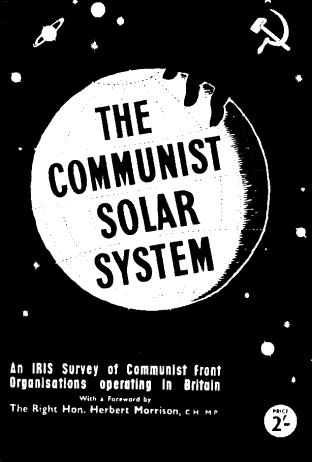
That autumn its Bulletin reported that there had been moves at the Labour Party conference that year to get it proscribed, put on the list of organisations which a member of the Labour Party was not allowed to join, but the motion to that effect ‘was among the many crowded out from discussion.’ (59) Perhaps because of the threat of proscription, Common Cause created a ‘front’ organisation, Industrial Research and Information Services (IRIS), the following year. Its first big pamphlet, The Communist Solar System (1957), a study of ‘Communist front organisations in Britain’, (published by Hollis and Carter) announced that IRIS was founded to provide trade unionists with the facts enabling them ‘to protect them from the insidious encroachments of Communists and ‘fellow travellers’ ‘.
Common Cause split soon after the birth of IRIS. At the end of 1956 C. A. Smith resigned along with Advisory Council members Phillip Fothergill, Bob Edwards, Lord Ammon, Professor Arthur Newell and Sydney Walton. According to a report in The Times (April 6 ’57) this group complained that the organisation had become ‘reactionary’ and that the promised democratic structure for the organisation had not been created — something which would have been important to ex-socialists like Smith and the trade unionists. The reactionary faction included Major-General Richard Hilton, a member of the BLEF and former Military Attache in Moscow . As this ‘Council’ was largely a ‘note-paper job’, and you got there by invitation, the choice of Hilton, who turns up a decade later in the National Front, is rather interesting.
In August 1956 ‘Common Cause Ltd.’ had been registered, owned and controlled by the ‘reactionary’ faction. The timing of these events is interesting. IRIS and Common Cause Ltd must have been thought of around the same time. The first IRIS News appeared in September: Common Cause Ltd. was registered in August. The Smith faction split perhaps a couple of months later. The whole orientation of the organisation was changed. A political coup seems to have been run: Smith lost the organisation he founded. It always looked like an unstable marriage — trade union leaders, Field-Marshalls and Tory MP’s in a ‘common cause’ against communism. We suspect, but can’t yet prove, that the coup was run by people whose intelligence links were more direct, and who found the organisation too useful to be weighed down with the baggage of membership and procedure.
The split turned into a dispute: the Smith faction continued, claiming to be the real Common Cause. It organised a ‘grass roots’ conference in May 1958, but to no avail: the other faction had retained the funding. The Smith-led Common Cause formally dissolved in May 1959. On dissolution the Smith faction passed a resolution condemning ‘the self-appointed Elizabeth Street committee, which improperly styles itself the national executive committee of Common Cause, for betraying Common Cause principles and attempting to degrade our movement into a purely negative anti-Communist organisation in order to secure finanical support.’ (60) The resolution suggests that the financial benefactor was calling the tune. Who was paying the piper? In 1964 one of the Common Cause Ltd. faction said that the branch structure had been abandoned because ‘branches can too easily be infiltrated.’ (61)
The original directors of Common Cause Ltd., the ‘reactionary’ faction, were: (62)
- Peter Crane — the director of a large number of American firms, including Dresser Manufacturing, Collins Radio of England; and later of the Reader’s Digest Association. Both the Digest and Collins are now known to have substantial links to the CIA. Collins Radio was one of the many sources of ‘cover’ used by the CIA and the Reader’s Digest has been extensively used to run CIA disinformation. (63)
- David Pelham James — a Conservative M.P. for fourteen years, James was a Director of the Catholic publishing house, Hollis and Carter, the publishers of the 1957 IRIS pamphlet ‘The Communist Solar System’. There were a number of Catholics in and around the Common Cause/IRIS groups. Andrew McKeown, with IRIS as company secretary and then, according to Paul Ferris, as the man running it, is a Catholic. (64) We don’t have enough information to know yet, but it is our suspicion that both groups were largely run by Catholics.
- Neil Elles — a barrister, later a member of the spook outfit, INTERDOC, a kind of European-wide Common Cause. INTERDOC is discussed below in the appendix.
- Christopher Blackett — a Scottish landowner and farmer, and, we presume but can’t prove, a relative of Frances Blackett, the original secretary of the BLEF. (65)
IRIS
IRIS set up in the headquarters of the National Union of Seamen (NUS), Maritime House. At the beginning IRIS Ltd. listed three directors: Jack Tanner, William McLaine and Charles Sonnex. Sonnex was Secretary and Managing Director, and James L. Nash was the Manager.
- Jack Tanner was the retired President of the engineers’ union, AEU and a former member of the TUC’s International Committee. Between 1948 and 1957 twenty-three people were members of the International Committee. Three were supporters of Moral Re-Armament; three – Tanner, Hancock and O’Brien – were members of Common Cause, and three of IRIS. O’Brien was also on the General Council and Executive Board of the CIA-funded and controlled, ICFTU from ’51-53. A good indication of the orientation of the members of this committee is the fact that 7 of that 23 — Yates, O’Brien, Roberts, Birch, Douglas and Williamson — were knighted and one, Flora Hancock, was made the equivalent, a Dame.
- William McLaine had been assistant General Secretary of the AEU from 1938 to 1947.
- James Nash left IRIS and joined the CIA-controlled International Confederation of Free Trade Unions. (66)
- Charles Sonnex was the link with the parent body, Common Cause.(67)
Others involved included: Stanley James, ex-assistant General Secretary and Treasurer of the NUS, and William Macklin, ‘for just over twenty-five years (the) convener of the anti-political extremist group in the original woodworkers union (ASW)’ later UCATT. IRIS was the Common Cause ‘Industrial Wing’, set up independently under Jack Tanner and funded by Common Cause until 1963, ‘when it established its own machinery to service politically-moderate trade union leaders.'(68) Servic(ing) trade union leaders?
IRIS, like Common Cause, is more important than has generally been thought. Labour MP and Wilson Cabinet member, Charles Pannell (later Lord Pannell) described to Irving Richter in the early 1970s his friendship with Cecil Hallett, General Secretary of the AEU (and Common Cause Council member), and ‘their combined efforts to defeat the Left (n.b. not ‘the communists’) in the industrial and political wings of the movement, by building ‘IRIS cells’. The work he and Hallett performed through IRIS cells, Pannell felt, did ‘more than any single thing to reverse the direction of the AEU, the pivotal union, when the Left Wing was about to throw Hugh Gaitskell to the wolves’ …..’ (69) The AEU ‘IRIS cell’ structure operated under cover as ‘The Club’ or ‘The Group’. The national co-ordinator of ‘The Club’ was (Sir) John Boyd who later became a director of IRIS and its recently revealed funding body the Industrial Trust. (70)
The biographer of former TUC President, Vic Feather, noted that Feather ‘was prepared to use the informal channels of Common Cause and Industrial Research and Information Services to reach into union branches ….. Feather was in touch with them, but was not active within them. Their main use to him was as distributing agencies.’ (71) Feather played a crucial role in the unseating of the communists from the Electrical Trades Union which climaxed with the famous 1961 court case over ballot rigging. His role was to sustain the leader of the anti-communist campaign, Les Cannon, after he had lost his job as head of the ETU educational centre. ‘It meant underwriting the Cannon domestic budget. One of Feather’s associates outside the Labour Movement was David James …… They had served together on the Outward Bound trust. Feather went to see him and explained the problem. James agreed to help, and arranged for a group of Catholic businessmen to pay Cannon a weekly subsistence allowance. It was neither the only nor the biggest outside contribution to the campaign, but it came at a critical moment.’ Feather’s biographer, Eric Silver, doesn’t reveal who gave the larger contributions nor does he tell the reader that James was a director of Common Cause. (72)
IRIS’s activities broke the TUC rules about the operation of clandestine groups inside unions, rules originally introduced to attack the Communist Party. In 1960 an embarassed TUC General Council had to support a motion condemning IRIS for its activities. After E. Mackenzie of the Association of Engineering and Shipbuilding Draftsmen described IRIS activities to the conference, General Secretary Vincent Tewson, one of the corner-stones of the TUC’s anti-communist/anti-socialist strategies since the end of the war, had to acknowledge that ‘it would be impossible for the (General) council to reject this motion ….. (but) they have resented on many occasions in the Congress the infiltration and far more insiduous propaganda which comes from some other bodies …..’. (73)
Common Cause’s published lists of alleged Communist Party members and fronts – and privately circulated others. Who did the research in the early years we don’t know. In 1970 Common Cause more or less acknowledged that an intelligence agency – presumably MI5’s ‘F’ Branch – was then the source. Bulletin 127, Summer 1970, announced that its study of the ‘communist challenge’ was based on ‘original sources and materials, the like of which have not been previously made public’. ‘Original sources’ was not an exaggeration. In 1974, with the perceived industrial and political crisis deepening, Common Cause actually published the entire structure of the Communist Party of Great Britain, right down to the membership of the most insignificant regional sub committees — the kind of detailed information then only obtainable by comprehensive penetration of the party. Major General Stainforth, Common Cause’s current administrator, told us in 1987 that this was all the work of one man, the late Jack Hill, who had ‘the connections’. Hill wrote under the nom de plume of ‘David Williams ‘ and edited the Common Cause Bulletin in the sixties and seventies. (‘David Williams’ contributed an essay to the 1970 anthology We Will Bury You edited by Brian Crozier.)
Conclusions
The material above is incomplete, under researched and does not sustain the following conclusions. Nevertheless, this is what we believe, this is how it feels. When the CIA took over the British exile groups, they also ‘acquired’ the groups’ UK support networks. Acquiring ABN, for example, they also ‘acquired’ the British League for European Freedom; and also the BLEF’s domestic wing, Common Cause. Common Cause was a useful outfit with crediblity within a section of the Labour movement. So the name was appropriated by Common Cause Ltd, the membership structure dumped, new funding located, an industrial wing (IRIS) created, and the entire operation became more clandestine and more narrowly focused on the Communist Party and its fronts. In short, in our opinion the Common Cause – IRIS network, from 1956 onwards, was a CIA operation at some level, perhaps just the funding. It just is too great a coincidence that two of the chairmen of Common Cause Ltd in the 56-75 period should both be directors of companies known to serve as CIA cover – Crane with Collins Radio and his successor, Peter de Peterson, with J. Walter Thompson. For how long the Agency’s role was maintained, we don’t know.
By the standards of other CIA operations in Europe – eg the millions of dollars spent in Italy in Italy – Common Cause/IRIS was a small, cheap operation. But it paid off handsomely in 1961 when, as Cecil Hallett of Common Cause/IRIS decribes, the AEU was able to reverse the Although Common Cause appears to have been a purely domestic operation its Articles of assocation state that it, ‘aimed to co-operate with similar organisations in other countries.’ One of those bodies was INTERDOC with whom they interlocked via Neil Elles
Appendix INTERDOC
INTERDOC, the Information and Documentation Centre, collected intelligence on leftist organisations throughout Europe. It appears to have evolved from a series of meetings in the late fifties. The first, according to INTERDOC’s own publications was, in the South of France in 1957 when French and German industrialists, academics, journalists and armed forces representatives met to discuss what steps they could take to combat Communism. In 1958 Dutch, British, Italian, Belgian and Swiss representatives joined them for an informal meeting.
As far as we know, the first product of these discussions was the Swiss Eastern Institute, founded in Berne, in 1959, ‘to study and collect information on the development of Communist countries.’ The founder and director of the Institute was 34 year old Peter Sager, a graduate of the Soviet Union study programme at Harvard University. (76). In 1958 Sager set up a bookshop specialising in books on the Eastern bloc with his wife and fellow Institute member Peter Dolder. The following August, C. C. Van Den Heuvel, a civil servant in the Dutch Ministry of Internal Affairs, – an officer of the Dutch Internal Security Service (the BVD) – set up in The Hague a foundation for research into human ecology. This appears to have been a front organisation: it soon became the East West Foundation with funding from the Dutch security service. (This use of ‘human ecology’ is strikingly similar to the American ‘human ecology’ foundations set up in the same period, later found to have been funded by the CIA. (77)
According to an Italian Secret Service (SIFAR) document dated October 1973, there was a meeting at Brabizon, near Paris, on 5-8th October 1961 where ‘the participants decided to unite behind [a] new organisation all efforts and initiatives of the struggle against communism and place these on a serious and expert footing.’ (78) (According to the SIFAR document, this meeting had been financed by the Dutch Secret Service.) The new organisation was INTERDOC which was formerly set up in February 1963 in The Hague with money from Royal Dutch Shell. Its aim was ‘Documentation in the field of Western values and world communism and the informing of the public on these matters. This aim is to be pursued through the establishment of an international documentation centre, which will co-operate with national centres in different countries.’ (79)
The organisation received material from affiliated groups throughout Europe and acted as ‘an international clearing house’. According to an internal INTERDOC report ‘an index system, a library, a collection of periodicals, a collection of special reports, documents etc.’ is maintained in the Hague and used by ‘official departments dealing with East-West Affairs; International companies and Organisations of employers.’ Newspapers and periodicals are also believed to have received INTERDOC material. (80)
Founding members were Van Den Heuvel and Dr. Norman von Grote, who represented a similar institute in Munich, West Germany. Dutch representatives included a colleague of Heuvel, Louis Einthoven, Herman Jan Rijks, and Dr J. M. Hornix. Grote had been a ranking official in Wermacht Eastern front intelligence with special responsibility for liaison with Vlassov and the NTS. Others from Grote’s organisation, the ‘Verein zur Erforschung sozial-politishcer Verhaltnisse im Ausland e. V.’ were Prof. Hans Lades and Dr. C. D. Kernig. During the sixties money appears to have come from West Germany, Great Britain and the United States. In his 1975 autobiography (published in Holland) Einthoven states that he was lobbying for support in France, Holland, Italy, Switzerland, Israel and even Indonesia. Personal links were developed with the Bilderberg group.
In the The Black-Pincered Crab by E. Verhoeven and F. Uytterhagen (Holland 1982) the authors state that INTERDOC was part of the World Anti-Communist League (WACL), though no real proof is offered. But Van Den Heuvel was apparently the Dutch representative of WACL. A complex network, about which we know only fragments, opens up here. One of those at the INTERDOC foundation meeting was Professor Luigi Gedda, head of the Mendel Institute in Rome. (81) Gedda was on the editorial board of the journal Mankind Quarterly which gave a spurious academic gloss to ‘intelligent racism’ in the guise of ethnic diversity. The editor and founder of Mankind Quarterly was Roger Pearson, founder of the Northern League. The Northern League for Pan-Nordic Friendship and Co-operation was founded in Scotland in 1958, but in 1962 the World Headquarters (sic) moved to Amsterdam. (82) Pearson was a later sponsor of WACL.
INTERDOC’s British affiliate body was the East West Study Group which in turn was linked to other anti-communist groups by the INTERDOC Advisory Board. In 1969 members of the Board included John Detmer, general secretary of the Economic League; Neil Elles of Common Cause (whose wife, a European M.P., was in the mid-seventies secretary of the Conservative Party International Department); and Brian Crozier, whose presence there may have been because of his involvement with Soviet Analyst which appears to have operated similarly to the Swiss East West Institute. (83) However, the two most interesting INTERDOC members were the former intelligence personnel, Walter Bell and Charles Ellis.
In 1963 Charles Ellis wrote to Sir William Stephenson (84) to tell him that he had been recommended to a new organization by his former boss at MI6, Sir Stewart Menzies. ‘I am kept busy with this INTERDOC organization. And together with other chaps, I have formed a working committee which is organising an international conference at Oxford in September.’ Ellis was at the time attached to the spooks’ college St. Antony’s. ‘We have raised money from — — —(deleted in book), and some professional groups, much to the astonishment of the Foreign Office who said that it couldn’t be done.’
Who provided the money is not revealed but in this period Ellis was in close touch with the American Ambassador in London, David Bruce. (85) Bruce had known Ellis since the war when he was in the OSS and Ellis had acted as a liaison officer to the Americans in the British Security Co-Ordination organization. Ellis continued to Stephenson, ‘They are now wondering if it was a good thing to kick me out of (MI6) ……. as several of us are now doing privately what they have never been succeeded in doing – getting an ‘action group’ going. We are keeping it ‘private and confidential’, as publicity could kill it.’ What this ‘action group’ did is unknown. (86)
It has become quite widely accepted that Ellis was a spy for the Soviets. This story first took root in Chapman Pincher’s Their Trade is Treachery. Pincher added to it in a letter (6 May 1981) in The Times where he refers to Ellis joining INTERDOC and goes on to tell the story that Ellis had ‘confessed’ to being a Nazi spy. ‘The fact that he was also deeply suspected of spying for Russia has been confirmed to me during the past week by a person well-known in the intelligence world but who wishes to remain anonymous.’ This would appear to be a reference to Peter Wright who was the major source for Their Trade is Treachery – and for the Ellis story. The published evidence for Ellis’ alleged spying is remarkably thin. A much more likely explanation for his dealing with the nazis is that he was following the policy of Menzies and those within MI6 who were looking for a negotiated end to the war with Germany. Before the war Ellis had extensive links with exile groups and White Russians. The common thread here is anti-communism.
Walter Bell retired in 1967 from MI5 where he had acted as adviser to a number of Commonwealth governments. During the war, like Ellis, he acted as link man with the OSS in London, though for MI6 not BSC. (Bell and Ellis played important advisory roles in the formation of the CIA.) Bell was apparently responsible for securing funding for INTERDOC from British sources. (87)
We know virtually nothing about the London-based East West Study Group, or the relationship which we presume existed with the Foreign Affairs Circle, founded by Geoffrey Stewart-Smith in 1962. The Vice-President of the Foreign Affairs Circle was a leading Tory peer and war-time intelligence operative, Lord St. Oswald, and the President was Lady Birdwood, Council member of the British League for European Freedom and erstwhile member of the C. A. Smith faction of Common Cause. (88) The Circle’s journal, the East-West Digest, was financed, according to Stewart-Smith, ‘by some well-wishers in British industry.’ Both Lady Birdwood (via the British League for European Freedom) and Stewart-Smith (via the Foreign Affairs Circle) were to become the British WACL affiliates. (89) In the 1970s, as the Foreign Affairs Research Institute, Stewart-Smith’s organization distributed the journals of all the groups mentioned in this essay. Whether there were more substantial ties we don’t know.
As can be seen, our knowledge of INTERDOC and its affiliates is at present extremely thin. This last section is provisional and should be treated with caution. Even so, the outlines of some kind of European-wide intelligence and propaganda network, staffed by serving and former intelligence officers, is visible. This is a rich seam still to be mined.
Thanks go to Stuart Christie, K. Koster (AMOK documentation, Holland), Morris Riley and Chris Horrie for material on INTERDOC.
Notes
- See e.g. Lyn Smith, ‘Covert British propaganda: The Information Research Department: 1947-77, in Millennium: Journal of International Studies, Vol.9, no.1 p.68: ‘Christopher Mayhew….. was the man who created IRD.’
- Ray Merrick, ‘The Russia Committee of the British Foreign Office and the Cold War, 1946-47, in Journal of Contemporary History, Vol.20 (1985) pp.453-468.
- ibid p. 465
- Christopher Mayhew, Time to Explain, (Hutchinson, London 1987) p. 107.
- Richard Fletcher, ‘British Propaganda Since WW2’, in Media, Culture and Society vol 4 p 98.
- Notes on meeting between Christopher Warner and Edward Barrett, in London, Saturday May 20, 1950, in Foreign Relations of the United States 1950 (Government Printing Office, Washington D.C. 1977) pp. 1641-6.
- Mayhew apparently thought, and still thinks, that it did. Letter to authors (15 April ’88)
- Anthony Verrier, Through the Looking Glass: British Foreign Policy in the Age of Illusions (Jonathan Cape, London 1982) p. 52.
- Christopher Mayhew (note 4) p. 111
- As Note 6.
- Jeffrey Harrod, Trade Union Foreign Policy (Macmillan, London, 1972) p.105.
- Fletcher (note 5) p 98
- ibid p 98
- The Times 2 December 1948
- Transcript of Lynskey Tribunal, HMSO 1948
- ibid p. 337
- Stanley Wade Baron, The Contact Man: Sydney Stanley and the Lynskey Tribunal, (Secker and Warburg, London, 1966) p. 169.
- Lynskey Tribunal (note 15) p 445
- ibid p 414
- Philip Williams (ed), The Diary of Hugh Gaitskell (Jonathan Cape, London 1983) pp. 89/90.
- Lynskey Tribunal (note 15) p. 446
- Lyn Smith, (note 1) p. 71
- ‘Maintaining Capitalism’, in Labour Research (February 1985)
- Tom Hopkinson, Of This Our Time: A Journalist’s Story, 1905-50 (Hutchinson, London 1982) p. 191
- ibid
- On Britanova see, for example, the two long articles by Richard Fletcher on IRD in Tribune 2 September ’83 and 9 September ’83.
- Patrick Mayhew (ed) One Family’s War (Futura, London, 1987) pp. 181-2.
- Hopkinson (note 24) p. 261
- Robin Maugham, Escape From the Shadows (Hodder and Stoughton, London 1972) p.171.
- See George W. Ross, The Nationalisation of Steel (MacGibbon and Kee 1965) pp. 85-6. After changing his name to Bulmer-Thomas, he stood as a Tory in the 1950 General Election and was defeated.
- Stokes in BLEF, The Duchess of Atholl, Working Partnership (London 1958) p 245; Stokes in Right Club, Dr. Pauline Henri, ‘Verge of Treason’ in Searchlight October 1989. When discussing new junior ministerial posts in 1951, Attlee told Hugh Dalton, that Ian Mikardo and Austen Albu ‘both belonged to the Chosen People, and he didn’t think he wanted any more of them’. Ben Pimlott, Hugh Dalton (Papermac, London, 1986) p. 596
- Duchess of Atholl (note 31) p. 252
- ibid
- The Duchess of Atholl was quite widely known before the war as – that oddity – a Tory (former Cabinet Minister) who supported the Republican cause in Spain. For this she was known then as ‘the Red Duchess’ and regarded by the right as a dupe of the left.
- How important the Imperial Policy Group input into these two groups was we cannot yet evaluate – just as it is impossible to decide if IPG itself (or its longest surviving member, Kenneth de Courcy) are more than interesting fringe phenomena.
- John Loftus The Belarus Secret (Penguin 1983) p. 204
- De Courcy was a friend of the Duke of Windsor before and after the war. See e.g. Charles Higham, Wallis (Pan, London 1988) pp. 214- 5.
- This, and most of the information on Smith’s career, has come from an as-yet unpublished profile of Smith written for the Dictionary of Labour Biography by Dr. Raymond Challinor, to whom our thanks.
- Richard Fletcher, Who Were They Travelling With? (Spokesman Books, Nottingham 1977) p. 70.
- Stefan Korbonski Warsaw in Exile (George Allen & Unwin 1966) p. 20.
- Fletcher (note 39) p.71
- Christopher Simpson, Blowback: America’s Recruitment of Nazi’s and Its Effects on the Cold War (Weidenfeld & Nicholson, London 1988) p. 8.
- ibid p. 222
- ibid p.269
- Nikolai Yakolev, CIA target – the USSR (Progress, Moscow, 1982) pp.104-5
- WACL meeting in Charles Goldman, ‘World Anti-Communist League’ adapted from Under Dackke ed. Frik Jensen and Petter Sommerfelt (Demos, Copenhagen 1978). We don’t know which journal published the Goldman piece, as there are no details on our photocopy, but the style suggests an early issue of the now defunct Counterspy. Dallas’ career, with some of the later associations glossed over, is described by his son in the Dictionary of Labour Biography, eds. Saville and Bellamy Vol.4 (1977).
- TheTimes 31/12/56, ‘Many Campaigners in War Against Communism.’
- Letter to authors, 30 March 1988
- V.L. Allen, The Russians are Coming: The Politics of Anti-Sovietism (Moor Press, 1987) p. 285
- Kevin Muir, Secretary, Catholic Church’s Committee for the World of Work (Letter to authors 15 April 1988)
- Michael Bialuguski The Petrov Story (William Heinemann, London 1955) p. 245
- Simpson (note 42) p. 179
- Garth Lean Frank Buchman: A Life (Constable, London 1985) p. 335
- ibid. pp. 423-4: Times 22 September 1953
- Information from Martin Walker.
- Hancock was a complete reactionary. As Chief Woman Officer of the TGWU, she was under the thumb of Deakin. With O’Brien, she was also with a Director of the Labour supporting Daily Herald (1955-57). Frank Cousins fought a bitter campaign to have her removed.
- Edwards was another radical who moved to the right. He served in Spain and was National Chair of the ILP, 1943-48. Founder of the Socialist Movement for United States of Europe, he became heavily involved in European organisations. Labour M.P., 1955-8. During 1948 the Chemical Workers Union had been involved in protracted legal proceedings over alleged forged ballot papers by the Communists.
- London had its own elaborate factional machine, the Progressive Labour Group. It had been formed in 1949 and was initially ‘designed to thwart Communist attempts to capture union posts.’ However, the definition of ‘fellow-traveller’ used by the P.L.G. tended also to embrace many on the Labour Left. Lewis Minkin, The Labour Party Conference, (Allen Lane, London 1978) p. 104
- Common Cause, Bulletin No.42, November 1955. For which read, perhaps, ‘our friends fixed the agenda’.
- The Times 11/5/59
- Sunday Times 31/5/64
- Labour Research March 1971
- CIA links in Fred Landis, ‘CIA and the Reader’s Digest’, in Covert Action Information Bulletin No.29, 1988. Landis’ analysis is concentrated on Latin America but even a casual look at the Digest’s British edition shows the same pattern. Collins Radio as CIA cover in P.D. Scott, The Dallas Conspiracy, ch. 11 p. 3 (unpublished manuscript)
- Paul Ferris The New Militants (Penguin 1972) p. 85
- Frances Blackett in Duchess of Atholl (note 31) p. 250
- Don Thomson and Rodney Larson, Where Were You Brother? (War on Want, London 1978) p. 30
- The Times 6 April 1957
- Macklin quote and description in memorandum of The Trade Union Education Centre for Democratic Socialism, 12 May 1975.
- Irving Richter, Political Purpose in Trade Unions (London 1973) pp. 144-5
- Minkin (note 58) pp. 180-1
- Eric Silver Vic Feather, TUC (Gollancz, London, 1973) p. 109
- ibid
- TUC Report 1960pp. 485-6.
- [Footnote omitted from original]
- [Footnote omitted from original]
- The World of Learning, 1980-81 (Switzerland) p 1236
- See Chapter 9, ‘Human Ecology’ in John Marks, The Search for the ‘Manchurian Candidate’: The CIA and Mind Control (Allen Lane, London 1979). In 1955 the CIA incorporated the Society for the Study of Human Ecology which was renamed the Human Ecology Fund in 1961 and was used as a CIA controlled funding mechanism for studies and experiments in the behavioural sciences.
- Liberation 9 October 1975 and L’Orchestra Noir, Frederick Laurent (Stock, Paris, 1978)
- INTERDOC registration papers deposited in The Hague.
- The Digger 11 March 1988
- See Kevin Coogan, ‘The Importance of Robert Gayre’, in Parapolitics USA No.2, 30 May 1981
- George Thayer, The British Political Fringe (Anthony Blond, London 1965) p. 102
- The Digger (note 80)
- William Stevenson, Intrepid’s Last Case (Michael Joseph, London, 1984) p. 253.
- Unpublished Bruce Diary, courtesy of the United States State Department.
- For Philby’s views of such ‘action groups’ see Lobster 16 p.10.
- The Digger (note 80)
- ‘Lord Birdwood who had and extremely distinguished record had died and I asked Lady Birdwood to join us. There was not the slightest indication that she held anti-democratic, racialist or anti-semitic views then. Over the course of time her views changed and became incompatible with mine. She then went off on her own getting more and more extreme as time past.’ Letter from Stewart-Smith to authors 21/12/87.
- For full background on Stewart-Smith see the Parliamentary Profile (1974) ‘Discreet Anti-Communist’ by Andrew Roth.