
Last year, in the search for independent corroboration of some of Colin Wallace’s story, I talked to a number of ‘Irish hands’, journalists who had been in Northern Ireland while Wallace was working there. One was Kevin Dowling, the Sunday Mirror correspondent there from 1970-74. Dowling was reluctant to talk much about that period of his life but, yes, he remembered Wallace, and knew about the psy ops unit Information Policy. He mentioned a novel about his time there he had written. It had caused trouble for him, been withdrawn after someone chucked a writ at it. It was a brief chat and Dowling’s novel went onto the long list of things I had to look into one day. Then in October I discovered a copy of it in my local branch library.
It didn’t take long to see why it caused him trouble: Dowling talks of Information Policy, describes Wallace and blows some of the disinformation projects Wallace was working on. And this was published in 1979, when the whole thing was still a secret, before Wallace was fitted-up.
Wallace is ‘Major Bill McDowell’, Wallace to the life except for thick curly hair the then rapidly balding Wallace would have envied. In McDowell’s office Dowling’s journalist character, ‘Pascal’,
‘recognized the Major in several of the photos on display…
There was a smiling Santa McDowell, about to climb into a helicopter with a sack of toys in his hand. Here he was again, parachuting down to an orphanage garden, his scarlet robes tucked safely in his belt. (p61) . . . Pascal . . . admired McDowell; but McDowell frightened him a little.’ (p62)
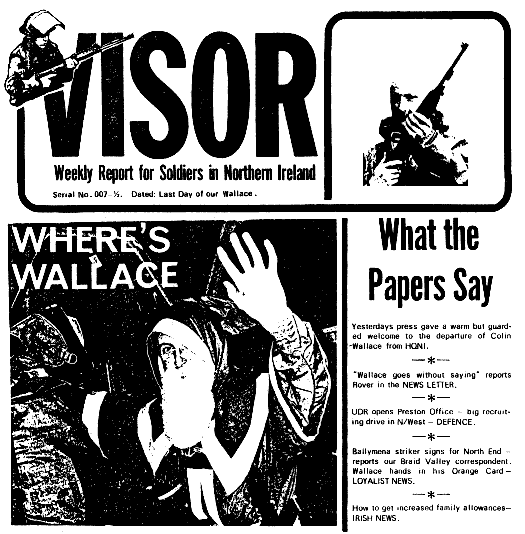 Right is a cropped version of one of the pictures Dowling is referring to. (It’s not very clear, a photocopy of a 13 year-old newspaper photograph.) It appears in a mock-up front cover of the British Army’s house journal, VISOR, produced in Lisburn by Army Public Relations as a leaving present for Wallace by his colleagues. Wallace is also the masked gun-man on the top corner. The lithographic plate made to print this is hanging on Wallace’s sitting room wall.
Dowling comments on the Information Policy/Public Relations relationship:
‘The Information Policy department was the cannon, Public Relations was merely the shell.’ (p62)
He mentions the IRD officer, Hugh Mooney, seconded to Information Policy –
‘an Anglo-Irishman who liaised with the Foreign Office and the British Information Service outlets in foreign embassies.’ (p62)
Did the press in Northern Ireland know about Information Policy?
‘Like many of the better-connected reporters covering Belfast, Pascal had regular contact with the Information Policy section … The British Army was leading the world in the development of ‘psychops’ (sic), a new branch of military science which relied less on muscle than on political persuasion by manipulation of the media.‘(p68)
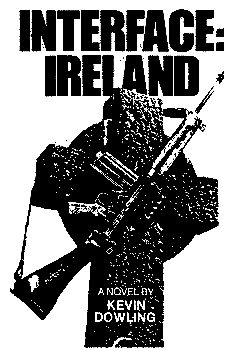 One of the narrative threads of Interface is the attempt by ‘McDowell’ to get ‘Pascal’ to print a story about corruption inside the Provos. ‘Pascal’ refuses it eventually but it is accepted by another journalist character, ‘Christopher Strickland’. In reality this was Chris Ryder, then with the Sunday Times which ran the corruption story. In Wallace’s account of this episode to me it ends with the British Army hiding Chris Ryder from Provo revenge after the story appeared in Butlin’s holiday camp at Bognor Regis.
There is one extraordinary paragraph on p213:
‘The police reporter from London had left the office and gone to a lunch in Lisburn. He was interviewing McDowell, who had information that the Provos had hired American veterans of the Vietnam war for five thousand dollars a month –
(The story run by Chapman Pincher in the Daily Express, reprinted on page 15 of Lobster 16)
– The Irish Godfathers sat around, smoking rich cheroots and robbing occasional banks, while the Yanks did the dangerous fighting. Pascal was grateful for the cynical freemasonry of veteran Belfast reporters, which had omitted to inform his London colleague that McDowell’s imagination had already reinforced the Provisional IRA with cadres of Vietcong, Czechoslovakians, Lithuanians and Communist Frenchmen.’
Dowling understood, had correctly ‘read’ some of the Information Policy operations. Other ‘Irish hands’ certainly knew of the unit. Why have none of them come forward and said so in the past two years? Because, preposterous though this may seem, we are still unable to persuade much of the media and almost the entire political system that Wallace ever was what he claims. Information Policy was a deniable operation, it has been denied, and none of the journalists who knew about it have made a sound. (With the exception of Dowling.)